



EM35x Common Specs
- Industry leading ARM Cortex-M3 based family of zigbee SoCs
- Exceptional RF performance
- 128 kB and 192 kB Flash variants available
- 12 kB RAM
- Large Flash/RAM variants to accommodate the most sophisticated applications
- Lowest deep sleep current and multiple sleep modes
- Excellent immunity to other 2.4 GHz devices for reliable co-existence
- Built-in memory protection
- Flexible antenna interface allows easy antenna connection with or without P
- Flash guaranteed for 20,000 write cycles, enhances token storage capability via SIM-EEPROM
- AES 128 hardware encryption engine with true random number generator
- Hardware supported network level debugging with packet trace port
- Capable of being zigbee Coordinator, Router, or End Device
- Multi-networks feature supported by EmberZNet PRO
Find the Right EM35x Device Select Columns
| Part Number | MCU Core | Flash | RAM | Frequency Range | Deep Sleep Current | USB | GPIO | 2nd Adj Channel Rejection | +12/-13 MHz 802.11g Rejection | TX Power | RX Current | TX Current | Crystal Frequency | Temperature Range (ºC) |
|---|---|---|---|---|---|---|---|---|---|---|---|---|---|---|
| ARM Cortex-M3 | 128 | 12 | 2400 2500 | 0.4 (no timer) | No | 24 | 46 | -55 8 | 26.5 | 31 (normal @ +3 dBm) | 24 | -40 85 — | ||
| ARM Cortex-M3 | 192 | 12 | 2400 2500 | 0.4 (no timer) | No | 24 | 46 | -55 8 | 26.5 | 31 (normal @ +3 dBm) | 24 | -40 85 — |
Sort A -> Z
Sort Z -> A
Filter by values...
EFR32MG Zigbee and Thread Starter Kit
The EFR32MG Wireless Starter Kit includes Zigbee and Thread software stacks, sample code, and integrated debug adapter. Multiple radio boards enable developers to create a mesh network and evaluate the EFR32MG Modules and SoCs.
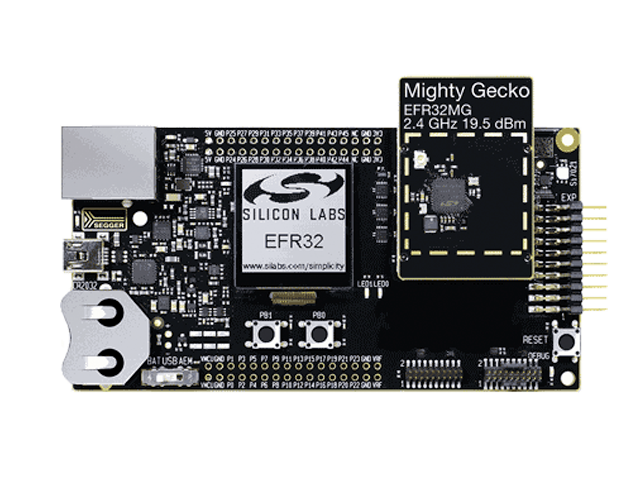
EFR32MG Zigbee and Thread Starter Kit
The EFR32MG Wireless Starter Kit includes Zigbee and Thread software stacks, sample code, and integrated debug adapter. Multiple radio boards enable developers to create a mesh network and evaluate the EFR32MG Modules and SoCs.