



Mastering the Multi-Radio Challenge of Coexistence in Modern IoT Devices
The IoT has evolved, and so have consumers. End users have come to expect more from their connected devices, including being able to communicate with the entire home ecosystem. Driven by standards like Matter, the market is demanding devices that speak multiple wireless languages. It's not enough for a smart hub, digital assistant, smart speaker, or set-top box to have only Wi-Fi. Now, these products are increasingly expected to act as full-fledged Thread Border Routers or Zigbee hubs. This requires integrating 802.15.4 radios alongside Wi-Fi and Bluetooth into a single, compact design.
Silicon Labs addresses this complex challenge head-on with its wireless SoCs and modules, which are purpose-built for robust, multi-protocol environments.
The Growing Pressure on 2.4 GHz Networks and What Interference Means for 802.15.4
The pressure on the 2.4 GHz band is relentless. Every new Wi-Fi router adds to the noise. For a low-power, low-data-rate protocol like 802.15.4, Wi-Fi interference is an existential threat to its reliability, which is its core value proposition
When an 802.15.4 radio encounters interference from a strong or nearby Wi-Fi transmission on an overlapping channel, it experiences several detrimental effects, including:
- Reduced range: The interference raises the effective noise floor through in-band interference. For a receiver to successfully decode a packet, the signal must be significantly stronger than the interference. As this interference increases, the effective range of the device shrinks dramatically.
- Increased latency: When a packet is corrupted by interference, it has to be retransmitted by the protocol. Additionally, CSMA/CA backoff delays increase. Each retry adds delay, leading to a sluggish and unresponsive user experience.
- Reduced battery life: Radio transmissions are the most power-hungry operations for a battery-powered IoT device. A high number of retries keeps the radio active longer, significantly reducing battery life potentially from years to months depending on conditions.
- Network Instability: In severe cases, a device may be unable to successfully transmit after multiple attempts, causing it to lose its connection to the network and require a rejoining process.
Understanding these impacts is key to appreciating why a robust coexistence strategy is a fundamental requirement for any successful IoT product.
The Limitations of Unmanaged Wireless Coexistence
The first line of defense against interference is unmanaged wireless coexistence, where systems operate independently but are designed to minimize conflict. This approach relies on a combination of physical design, protocol behavior, and radio performance.
One of the most effective techniques is frequency separation. By selecting channels that are distant from active Wi-Fi channels, 802.15.4 networks can reduce the likelihood of overlap. However, this strategy has limitations. Wi-Fi signals are wideband and often strong enough to interfere even with channels that are nominally non-overlapping. This is particularly true in environments where access points are located within a meter to IoT devices.
Spatial separation is another important consideration. Increasing the physical distance between devices or improving antenna isolation can significantly reduce interference. This is relatively straightforward for distributed end devices but becomes more challenging in compact, multi-radio products.
For devices interacting with a noisy external environment, "unmanaged" coexistence using a robust radio to passively resist interference - is beneficial. However, when multiple radios are operating tens of millimeters apart on the same circuit board, this strategy is insufficient. The raw power of a nearby Wi-Fi radio can completely overwhelm a low-power 802.15.4 radio.
For the complex multi-radio devices that are now becoming standard, a proactive, managed wireless coexistence strategy is needed.
Managed Wireless Coexistence: Packet Traffic Arbitration (PTA) is the Foundation of Cooperation
Managed coexistence moves from passive resilience to active, hardware-level coordination. The industry-standard mechanism for this is Packet Traffic Arbitration (PTA). Silicon Labs' EFR32MG24 SoCs provide flexible hardware support for all standard PTA configurations, allowing seamless integration with a wide variety of Wi-Fi chipsets.
As shown in the diagram below, Packet Traffic Arbitration operates on a simple but highly effective principle of request and grant signals exchanged between the MG24 (handling 802.15.4) and the Wi-Fi radio.
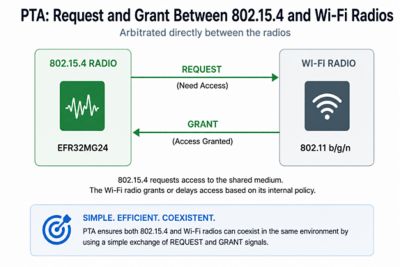
How Packet Traffic Arbitration Works
- 802.15.4 Needs Access
The 802.15.4 radio has data to send or receive. - Request Sent
The 802.15.4 radio asserts a REQUEST to the Wi-Fi radio. - Wi-Fi Evaluates
The Wi-Fi radio evaluates the request based on its internal policy (e.g., priority, fairness, current activity). - Grant Sent
The Wi-Fi radio asserts a GRANT back to the 802.15.4 radio. - Access Granted
The 802.15.4 radio uses the channel; the Wi-Fi radio pauses or defers its transmissions.
The level of coordination can be scaled depending on the system's needs:
- 2-Wire PTA: A COEX_REQ signal from the MG24 and a COEX_GRANT signal from the Wi-Fi radio.
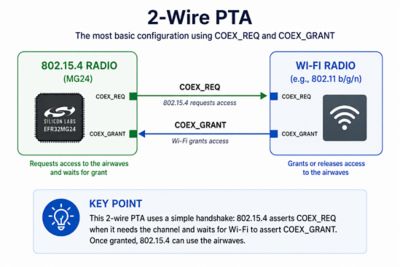
- Normal Operation: Wi-Fi is using the airwaves (No request — 802.15.4 is idle.)
- 802.15.4 Requests Access: MG24 asserts COEX_REQ to request the airwaves.
- Wi-Fi Grants Access: Wi-Fi acknowledges by asserting COEX_GRANT.
- 802.15.4 Transmits: MG24 now has the airwaves and can transmit/receive.
- 3-Wire PTA: Adds a COEX_PRIORITY signal, allowing the MG24 to flag the urgency of its request (e.g., a high-priority ACK vs. a low-priority sensor reading).
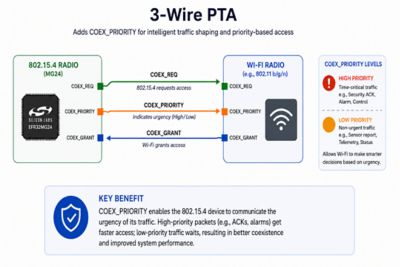
- 802.15.4 Needs Access: The MG24 has data to send or receive. (Wi-Fi may already be using the airwaves.)
- Request + Priority Sent: MG24 asserts COEX_REQ and sets COEX_PRIORITY to indicate urgency (High or Low).
- Wi-Fi Evaluates Priority: Wi-Fi evaluates the priority level and decides whether to grant access (immediate grant or delay/defer).
- Grant Returned: If access is granted, Wi-Fi asserts COEX_GRANT.
- 802.15.4 Uses the Airwaves: MG24 transmits or receives without Wi-Fi interference.
- 4-Wire PTA: Provides the richest context by adding signals that can specify the exact packet type (TX or RX), giving the Wi-Fi arbiter maximum information to manage traffic most efficiently.
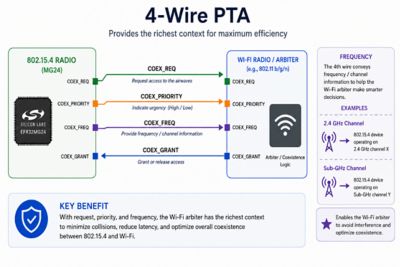
- 802.15.4 Needs Access: The MG24 has data to send or receive.
- COEX_REQ + COEX_PRIORITY + COEX_FREQ Sent: The MG24 asserts COEX_REQ and provides context using: COEX_PRIORITY for urgency and COEX_FREQ for frequency/channel information.
- Wi-Fi Evaluates Request + Frequency Context: The Wi-Fi radio evaluates the request using current activity, priority level, and COEX_FREQ frequency/channel information.
- COEX_GRANT Returned: If access is allowed, the Wi-Fi radio asserts COEX_GRANT.
- 802.15.4 Uses the Airwaves: The MG24 transmits or receives in a protected window while Wi-Fi defers its activity.
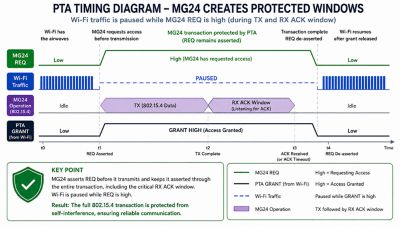
The timing diagram below illustrates how MG24 uses PTA to create clear, protected windows of operation. The MG24 asserts its REQ signal before its transmission begins. It keeps the REQ asserted not only for its own transmission (TX) but also for the critical window when it is waiting to receive an acknowledgment (RX ACK). Only after the entire transaction is complete does it de-assert the REQ. This process guarantees that the full 802.15.4 transaction is protected from self-interference.
Duty-Cycled Packet Traffic Arbitration for Advanced Management
For battery-powered devices where power conservation is important, the MG24 platform also supports duty-cycled PTA. Instead of a continuous request, the MG24 can be programmed to request access only during very specific, scheduled windows. The Wi-Fi radio, aware of this schedule, can proactively quiet itself just for those brief, critical moments. This minimizes the time the Wi-Fi radio is paused, increasing throughput while still helping to manage essential 802.15.4 traffic and saving power.
The Signal Identifier: A Patented Leap in MG24 Intelligence
Normal PTA allows the 802.15.4 radio to request access to the shared medium and can defer Wi-Fi activity to avoid collisions. However, this approach has inherent limitations. Without awareness of ongoing Bluetooth Low Energy (LE) or Zigbee activity during Wi-Fi idle periods, the system has to rely on conservative or aggressive scheduling strategies such as increased priority or duty cycling. These approaches can either degrade Wi-Fi performance or fail to guarantee reliable low-power wireless communication.
The Signal Identifier (SI), a unique and patented hardware feature integrated into the Silicon Labs MG24 SoC, adds a higher level of coexistence intelligence. Rather than detecting Wi-Fi packets, SI continuously monitors the airwaves for valid Bluetooth LE and Zigbee signals with protocol awareness.
During natural gaps between Wi-Fi transmissions, the SI listens for active Bluetooth LE or Zigbee packet activity. If a valid signal is detected, SI immediately asserts a high-priority PTA request to delay the next Wi-Fi transmission. This creates a protected receive window, allowing the Bluetooth LE or Zigbee packet to be successfully received without interference.
This intelligent coexistence mechanism enables the MG24 to dynamically protect critical low-power wireless traffic while minimizing unnecessary impact on Wi-Fi performance, delivering a major improvement in robustness and coexistence efficiency.
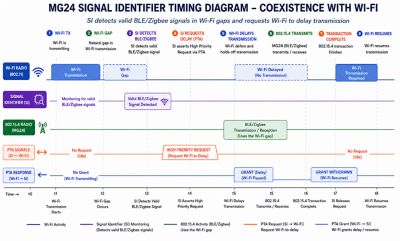
The following sequence highlights how the MG24’s Signal Identifier intelligently protects BLE and Zigbee traffic during Wi-Fi coexistence, enabling far more efficient and reliable operation than conventional PTA-only approaches:
- Wi-Fi transmission starts: The Wi-Fi radio is actively transmitting and occupying the channel.
- A Wi-Fi gap occurs: A natural gap appears between Wi-Fi packets, creating a short opportunity for other radios to communicate.
- SI detects a valid Bluetooth LE/Zigbee Signal: During the Wi-Fi gap, the Si detects a valid Bluetooth LE or Zigbee packet on the airwaves.
- SI requests Wi-Fi delay: The SI immediately asserts a high-priority PTA request to delay the next Wi-Fi transmission.
- Wi-Fi defers transmission: The Wi-Fi radio honors the PTA request and temporarily pauses its next transmission.
- Bluetooth (LE)/Zigbee communication proceeds: The MG24 safely receives or transmits the Bluetooth LE/Zigbee packet during the protected window.
- Transaction completes: The Bluetooth LE/Zigbee communication finishes successfully without Wi-Fi interference.
- Wi-Fi resumes transmission: The PTA request is released, allowing Wi-Fi to resume normal transmissions.
This patented, intelligent coexistence mechanism transforms coexistence from a static scheduling problem into a dynamic, protocol-aware protection system. By selectively delaying Wi-Fi transmissions only when valid Bluetooth LE or Zigbee activity is detected, the MG24 delivers significantly improved wireless robustness and coexistence efficiency, serving as a key differentiator for the platform.
Managed Wireless Coexistence is a Requirement for the Modern Smart Home
As the smart home accelerates and standards like Matter push for more integrated functionality, managed coexistence is no longer a niche feature. The proliferation of OpenThread Border Router (OTBR) and hub functionality into a wider range of consumer devices makes it an essential requirement. By leveraging the comprehensive coexistence toolkit built into the Silicon Labs MG24 family, from flexible multi-wire PTA to the patented, intelligent Signal Identifier, developers can build the reliable, high-performance, multi-protocol devices that will power the next generation of the IoT.
