

Why Matter Energy Management Matters for Utilities, Device Makers, and Homeowners
The connected home is no longer just about convenience; it’s a dynamic energy environment. The growing adoption of EV chargers, heat pumps, solar systems, and smart appliances creates opportunities but also complexity. Disconnected apps and ecosystems make it difficult for homeowners to manage their energy, for utilities to coordinate demand, and for device makers to deliver seamless user experiences. Matter Energy Management helps address this by creating a common framework for connected energy devices.
What’s Matter Energy Management?
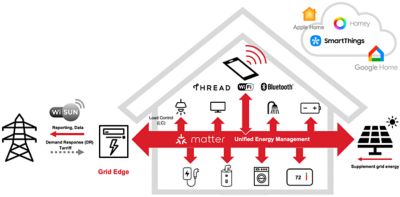
Matter Energy Management extends the Matter standard to energy use cases, giving devices a unified language to:
- Report power consumption and energy use
- Forecast near-term energy demand
- Respond to management signals from a hub or controller
- Coordinate with other devices in the home
- Optimize behavior based on cost, comfort, or grid conditions
This allows a Home Energy Management System (HEMS) to make intelligent decisions across the entire home. For example, a HEMS could automatically reduce EV charging current to prevent a panel overload, preheat water when electricity is cheap, or run the dishwasher during off-peak hours.
How Matter Energy Management Works
Report – Near real-time energy visibility
Predict – Near-term demand forcasting
Coordinate – Devices work together
Optimize – Cost, comfort, or grid
Respond – Tariffs and grid signals
For device manufacturers, this shift toward standardized energy coordination also changes how products need to be designed, requiring reliable, scalable connectivity across multiple protocols from the start.
What Types of Devices Are Covered?
Matter has continued to expand its Energy Management capabilities through recent releases, adding support for key device types that enable advanced home and site-level energy optimization. These include:
- Utility Meters: Can join the Matter network, allowing a HEMS to see the same certified data the utility uses for billing.
- Sub-Meters: Track power consumption for specific circuits to pinpoint energy usage.
- Energy Tariffs: Enables the system to understand utility rate structures, automatically shifting tasks to off-peak hours.
- Meter Reference Points: Acts as a foundational anchor to synchronize measurements from all energy devices, providing a holistic view of the home's energy flow.
Together, these device types provide the granular data needed for comprehensive energy management.
The Technical Building Blocks Behind Matter Energy
At its core, Matter Energy Management is built on standardized clusters and attributes that define how devices measure, report, and respond to energy information. These fall into four key areas:
- Measurement clusters - Enable consistent reporting of energy use, power, and load.
- Management and control clusters - Enable coordinated behavior and optimization.
- Application-specific clusters - Tailored features for device categories like EV chargers and water heaters.
- Preference, tariff, and topology clusters - To incorporate pricing, grid conditions, user preferences, and site-level power relationships.
These building blocks, including clusters like Commodity Tariff, Commodity Price, Electrical Grid Conditions, Energy Preference, Meter Identification, Commodity Metering, and Power Topology, provide the foundation for context-aware energy management across the home.
Real-World Application Examples
So, what can you do with Matter Energy? Perhaps the easiest way to answer this is through examples. The examples below give an overview of use-cases and functionalities of three Matter Energy Management applications, EVSE, water heaters, and smart appliances.
EV Charging
With Matter, EV chargers can align charging with low-cost hours, reduce current to avoid overloading the home's panel, and coordinate with other devices such as solar panels. This helps homeowners manage costs while enabling utilities to reduce peak demand, creating a foundation for future Vehicle-to-Grid (V2G) integration.
Water Heating
Water heaters can shift operation without impacting user comfort. Matter Energy Management allows a HEMS to preheat water when energy is cheap or abundant, balancing cost savings with comfort and providing load flexibility for utilities.
Smart Appliances
Dishwashers, washing machines, and dryers can participate in coordinated energy management by delaying or pausing cycles based on pricing signals, user preferences, or overall home energy conditions, automating efficiency without requiring user input.
The result is a more automated efficient home, where everyday tasks are optimized in the background without requiring constant user input.
Benefits for the Entire Ecosystem
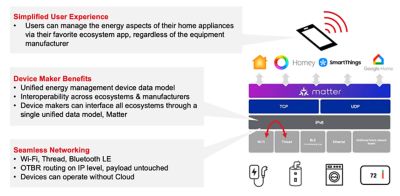
Matter Energy Management creates value across the entire ecosystem, benefiting utilities, device makers, and consumers. Silicon Labs supports this transition with integrated, multi-protocol wireless SoCs and Matter expertise that help reduce design complexity, streamline development, and accelerate deployment of interoperable energy devices.
Benefits for Utilities
For utilities struggling with grid strain and limited visibility "behind the meter," Matter Energy Management offers an interoperable foundation for demand response and load management. Key benefits include better coordination of flexible loads, improved use of dynamic pricing, smoother integration of distributed energy resources (DERs), and reduced stress during peak demand.
Benefits for Device Makers
Matter Energy Management solves market fragmentation. By creating a common application layer, it reduces development complexity and time-to-market. This allows manufacturers to eliminate custom integrations, reach a broader ecosystem, and focus engineering resources on product differentiation instead of interoperability.
Benefits for Consumers and Homeowners
For homeowners, Matter Energy Management breaks down walled gardens, creating a unified experience where all energy devices work together. This means lower energy costs through automated optimization, less hassle managing multiple apps, and more automation without sacrificing control.
Conclusions
Matter Energy Management is a critical step toward a connected, intelligent, and interoperable energy ecosystem. By standardizing how devices communicate and coordinate, it aligns the needs of utilities, homeowners, and device makers. For companies building the next generation of connected energy devices, the opportunity is not just to support a new standard, but to shape a unified energy market. Silicon Labs provides the Matter, Thread, and Wi-Fi solutions to simplify development and accelerate time-to-market.
Learn more about Silicon Labs Matter, Thread, and Wi-Fi solutions for smart energy!