

From Prototype to Production: Building IoT Through Open Source and Developer Communities
The way developers build connected products is changing. Open-source software, open standards, and developer communities have become an increasingly important part of how new technologies are discovered, evaluated, and ultimately brought into products.
For developers, the value goes well beyond access to source code. Open development provides greater transparency into how technologies work, makes it easier to start with proven implementations, and creates opportunities to learn from the experiences of a much broader IoT developer community.
At Silicon Labs, we have been investing in this approach across open standards, open-source projects, and developer ecosystems. We're now taking another step with Bluetooth Low Energy by expanding our open-source software and creating new ways for developers to engage directly with the code.
Extending Open Collaboration to Bluetooth LE
Silicon Labs has now expanded from making Bluetooth LE application examples available as open source to creating processes that enable customer engagement and code contribution through GitHub.
The model is simple: build and extend.
Developers can build using Silicon Labs sample applications, documentation, hardware, and tools. They can then extend those resources by raising issues, suggesting fixes, and contributing through pull requests.
When a contribution is accepted, it can move through our engineering and testing processes and potentially become part of a future SDK release. Issues and proposed solutions can also remain visible to other developers, creating another source of knowledge for the community.
This creates a feedback loop between the people developing the technology and the people putting it to work in real applications:
Build. Use. Pressure test. Share. Contribute. Review. Improve.
That doesn't mean every issue or contribution becomes product code. It means there are more opportunities to identify friction, expose software to different use cases, and bring useful developer insights back into the development process.
For developers, that can mean more transparency into how software works, more reusable resources to start from, and more ways to learn from and contribute to the technology they are using.
Why Open Source IoT Development Matters
Developers rarely work within the boundaries of a single company's development environment. They use GitHub repositories, open-source projects, standards-based software, community forums, development frameworks, and tools from across the industry.
This breadth gives developers more choice in how and where they build. It can speed development. Instead of starting from scratch, developers can use existing implementations and examples to evaluate a technology, understand how it works, and determine whether it can meet the requirements of their use case before integrating it into an application.
Open development also expands the knowledge available to developers. An issue encountered by one engineer may already have been investigated by someone else. An example developed for one application can provide the starting point for another. Discussions, issues, and proposed fixes remain available for others to learn from.
This is particularly valuable for smaller engineering teams. Access to expertise no longer has to depend entirely on direct engagement with a technology supplier. Community knowledge can complement supplier documentation and technical support, extending the resources developers can draw on as they work through a problem.
Diversity of use is another benefit. Once technology is in the hands of a broad developer community, it gets exercised across applications, environments, and implementation approaches that are difficult for any one engineering organization to replicate. That broader real-world exposure can uncover edge cases, integration challenges and opportunities for improvement. When paired with engineering review and testing, these signals can help strengthen the software everyone relies on.
Building on Open Standards, Software, and Ecosystems
The move to open-source Bluetooth LE development builds on an approach that isn't new to Silicon Labs. Our involvement in open standards and open-source projects has grown alongside the wireless IoT industry.
Matter, Thread and Zephyr are examples that demonstrate what can be accomplished when companies across the industry collaborate around common standards and open implementations. Silicon Labs has been actively involved in these ecosystems, including support for OpenThread and Matter, helping developers build interoperable connected products.
We are also expanding the ways developers can work with Silicon Labs technology through ecosystems such as Zephyr and Arduino.
Arduino is a fitting example of how an established developer ecosystem can make advanced wireless technologies more accessible. Developers can use Silicon Labs-based Arduino hardware and a familiar Arduino development model to experiment with technologies including Bluetooth LE, Matter, Thread, and Zigbee.
These broader developer communities are important because the knowledge within them extends well beyond any one technology supplier. A developer working with Arduino or Zephyr can learn from other developers, find examples and solutions, and contribute their own experience back to the ecosystem.
The Silicon Labs Community complements these broader communities by providing a place for developers to ask questions, share knowledge, and engage around Silicon Labs products and technologies. GitHub provides another path to work directly with open-source software and examples, raise issues, see proposed solutions, and increasingly contribute to the software itself.
No single community or channel needs to serve every purpose. Together, they give developers more places to find expertise, solve problems, and keep moving—whether the best answer comes from Silicon Labs or from another developer who has already encountered a similar challenge.
Supporting the IoT Development Journey from Prototype to Production
The range of resources available to developers becomes even more important when we look at the entire IoT development journey.
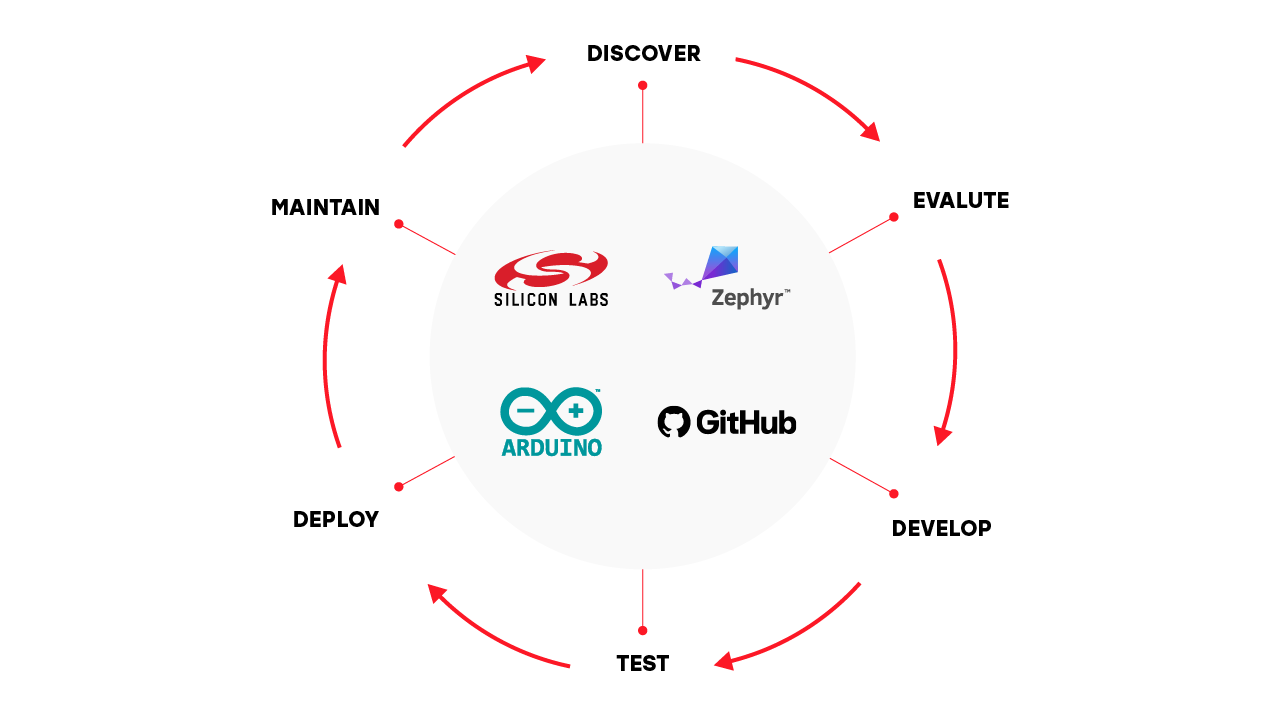
A developer may first encounter a technology through a community project or GitHub repository. Arduino may provide a fast way to prototype an idea. An open-source example can help answer an implementation question. As the design progresses, the developer's needs change.
Evaluation turns into development. Development moves into optimization and testing. Eventually, questions about security, power consumption, interoperability, certification, manufacturing, and long-term software maintenance become just as important as getting the application running.
No single method carries a developer through all of these stages.
That's why we look at open source and developer communities as part of the broader development experience. Open resources and community expertise need to connect to supported SDKs, development tools, documentation, hardware, and technical support so developers have a path forward as their products mature.
The goal is not simply to make it easier to prototype. It is to make it easier to start while providing a path to scale that idea into a product.
Developers as Participants in the Ecosystem
This is ultimately where we see the potential of open IoT development.
The traditional supplier model can be linear: develop software, publish it, and support developers as they use it. Open development adds another dimension by giving developers a more active role.
They aren't only consuming software. They are experimenting with it, applying it in ways its original developers may not have anticipated, identifying problems, sharing what they learn and, in some cases, contributing solutions.
The supplier still has an important role. For Silicon Labs, that includes maintaining engineering processes, reviewing contributions, testing software, and providing the production-ready technology developers need to build commercial products.
Community participation complements that work. It brings more perspectives and real-world experience into the ecosystem, while giving developers access to a broader base of knowledge than any single company could provide on its own.
What's Next in Open Source IoT Development?
Bluetooth LE is the next step in an approach we plan to expand across additional wireless technologies over time.
At the same time, we'll continue working across open standards, open-source projects and development ecosystems including Matter, Thread, Zephyr and Arduino. We'll also continue investing in the connections between those ecosystems, the Silicon Labs Community, our development tools and the resources developers need as they move toward production.
Open development doesn't replace the engineering work required to bring a connected product to market. Nor does community replace supplier expertise and support. Instead, they expand the resources and perspectives available to developers and create more opportunities for knowledge and improvements to flow across the ecosystem.
For us, that's the opportunity: make it easier for more developers to discover, evaluate, build, deploy, and maintain with wireless technology, while providing the foundation they need to take their ideas from prototype to production.
Explore. Build. Contribute.