



Whitepaper
Introduction
Sub-GHz networks have been the standard for products needing long-range, reliable connectivity for decades. These networks have historically been based on proprietary technologies optimized for specific applications. Recently, there has been an emergence of standards-based Sub-GHz protocols backed by alliances, lowering the barrier of entry for developers interested in these longrange technologies.
A great example of this standardization can be seen in the deployment of energy meters worldwide. These deployments have typically been based on proprietary star or mesh networks meant to isolate the metering infrastructure from threats while also providing ways for metering manufacturers to ensure that their deployments meet reliability and security requirements. Lately, there has been a major push from both municipalities and metering companies to take a more standards-based approach. This approach allows for cities to leverage smart metering as a connectivity backbone as they roll out larger smart ecosystems throughout their geography. These large deployments of line-powered devices provide the ideal base for expanding municipal connectivity to include batterypowered devices and expand use cases to more historically battery-powered applications. This expansion allows municipalities to leverage higher-cost infrastructure to improve efficiencies and lower overall costs throughout the scope of their responsibilities.

The IEEE 802.15.4g standard was developed to provide a platform for the expansion of smart cities using industry-standard PHYs to ease adoption and lower the complexity of networks. Protocols, like Wi-SUN, have been built on this standard to provide an interoperable solution that manufacturers can use and cities can adopt, to ensure that devices from multiple vendors can interact on the same network. Wi-SUN leverages a subset of the 802.15.4g standard to improve compatibility without limiting device functionality. Using both the FSK and OFDM modulation schemes outlined in the 802.15.4g standard, Wi-SUN allows users to select 8 different FSK configurations and 4 OFDM options to find the best solution for their application without limiting how other devices on the network interact. The inclusion of native IPv6 addressability in Wi-SUN allows for the simple inclusion of IP-based networks and removes the complexity that had been commonplace in previous sub-GHz based solutions.
The 802.15.4g standard, and the ICs that have been developed to support it, provide flexibility that has rarely been seen in sub-GHz networks. While this flexibility is a huge advantage, it brings complexity and forces designers to be more informed about the different PHY configurations and options that are available to them. Each configuration is uniquely positioned within the ecosystem to address the needs of different use cases and is optimized to allow developers to select the best fit for their application without limiting the network to the needs of that application.
In this whitepaper, we will cover some of the advanced features available with 802.15.4g and how they fit within the Wi-SUN protocol, the differences in the three PHYs defined in 802.15.4g, and some of the performance advantages of each as they relate to data rate and range.

FSK, OFDM, and O-QPSK
The 802.15.4g standard defines three different modulation schemes to standardize communication specifications for smart utility networks. These modulations are as follows:
- SUN FSK: Most commonly used scheme in existing networks.
- SUN OFDM: Used to provide higher bandwidth connectivity and lower latencies, enabling functionality like OTA.
- SUN O-QPSK: Provides a lower data rate, and longer-range option.
Each of these PHYs has been designed to bring different benefits to the network, giving developers optimal flexibility as they define and deploy their network. As with every design choice, there is not a single solution that will meet the needs of every end node, but the combination of the three supported PHYs within the standard allows for the selection of the best fit PHY for each application within the network.
SUN FSK and FEC
FSK modulation has been widely used across many applications in the US for years and the 802.15.4g defines specific PHY configurations that can be used as part of the SUN network. Wi-SUN uses a subset of these PHYs (shown in the table below) to support data rates from 50 –300 kbps with bandwidths ranging from 100 – 600 kHz.
| Bit rate (kbps) | Modulation index | BW-Ch spacing (kHz) | Operating mode | With FEC: Net bit rate (kbps) |
| 50 | 0.5 | 100 | #1a | 25 |
| 50 | 1 | 200 | #1b | 25 |
| 100 | 0.5 | 200 | #2a | 50 |
| 150 | 1 | 400 | #2b | 50 |
| 200 | 0.5 | 200-400* | #3 | 75 |
| 200 | 0.5 | 400 | #4a | 100 |
| 200 | 1.0 | 600 | #4b | 100 |
| 300 | 0.5 | 400-600* | #5 | 150 |
Of the PHYs defined as part of Wi-SUN and 802.15.4g, FSK is the simplest solution relying on a single carrier and data rate within each operating mode. This simplicity does come with some challenges that need to be considered. For example, to increase the data rate you also need to increase the channel bandwidth increasing the susceptibility of the network to noise.
FSK-based networks can also make use of FEC (forward error correction) to improve reliability and the network’s point-to-point range. However, in practicality, this does not make as much difference as one would expect. Adding FEC to an FSK PHY cuts the effective data rate in half for a given bandwidth or channel spacing. Except for the lowest data rate FSK PHY, there is no practical advantage to adding FEC. Looking at the chart below, you will see FSK Option 5 shown in green. This PHY supports a 300-kbps data rate, or a 150 kbps data rate with FEC, with a bandwidth of 600 kHz. With FEC enabled you see a sensitivity improvement from ~-103 to ~-107 dB. When you look at FSK Option 3 (shown in blue) you can see you get a similar sensitivity without FEC and can maintain a much narrower (400 kHz) bandwidth. In most instances, it would be much more beneficial to choose Option 3 and its lower bandwidth than it would to enable FEC on Option 5. FSK Option 1b shows significant improvement in Rx sensitivity with FEC enabled (-110 vs -115 dB), so in this very specific case it would be recommended if you need maximum point to point range and can absorb the 50% data rate reduction.
NA - 200/400/600 KHz channel spacing
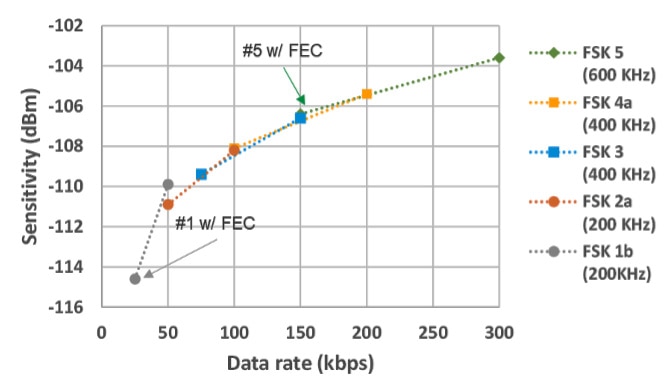
Figure 1 - FSK Data Rates and Sensitivities
SUN OFDM and its Advantages
OFDM was initially developed in the 1980s to support digital audio broadcasts before being adopted for digital TV in the 1990s and then as part of the Wi-Fi standard (802.11g/n…). It is a multi-carrier modulation that uses certain carriers for synchronization and others for data resulting in very efficient modulation and coding. OFDM has built-in scalability and flexibility utilizing the same synchronization for all MCS (Modulation and Coding Scheme) modes and using inpacket signaling for easy switching between modes without a configuration change.
It is very robust to multi-path interference making it ideal for urban environments. However, OFDM has very strict linearity requirements for power amplifiers which can result in limited output power to stay within specification limits. 802.15.4g specifies 4 different OFDM options (shown in the table below), each with configurable MCS levels (MCS0 – MCS6) within the option. These options support data rates from 12.5 kbps to 2.4 Mbps depending on the option and MCS level. Within a given option, MCS levels can be selected to scale data rates up to 24 times from MCS0 to MCS6 based on the immediate needs of the network. Silicon Labs has added support for MCS7 which provides a 50% bit rate increase over MCS6.
| OFDM option | Bandwidth (kHz) | Main regions | Bit rates (kbps) | Sensitivity (dBm) |
| 1 | 1200 | NA,BZ | 100 to 2400 (3600*) | -111 to -95 |
| 2 | 800 | NA, BZ, JP | 50 to 1200 (1800*) | -113 to -98 |
| 3 | 400 | NA, BZ, JP | 25 to 600 (900*) | -115 to -101 |
| 4 | 200 | NA, BZ, JP, EU | 12.5 to 300 (450*) | -116 to -104 |
Wi-SUN FAN 1.1 specifies the 4 OFDM options using MCS levels 0-6. The chart below shows the Rx sensitivity levels of the EFR32FG25 SoC and how those levels vary with the different data rates set by each option and MCS level. In general, the FG25 shows approximately 12-16 dB difference in Rx sensitivity across the various MCS levels within a given OFDM option which would result in a reduction in pointto-point range. Devices easily switch between different MCS levels in real time using the in-packet signaling functionality built into OFDM. This would allow them to operate at a lower data rate to achieve maximum reliability and then increase the data rate for a short period for higher throughput needs, like over-the-air (OTA) upgrades.
SUN OFDM Flexibility
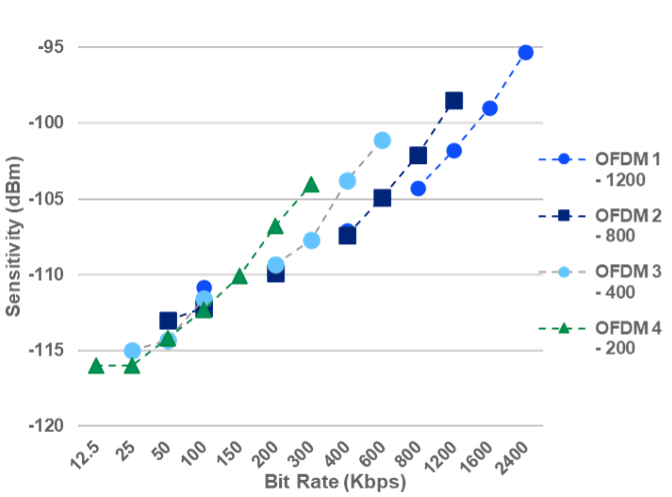
Figure 2 - Wi-SUN Data Rates and Sensitivities
In general, OFDM has some major advantages over FSK-based networks. It allows for higher data rates and throughput which enables efficient OTA upgrade implementation without consuming large amounts of network bandwidth or end device power. These higher data rates also result in shorter on-air time which can have major effects on large-scale networks. The shorter on-air times lower network congestion and improve robustness while also allowing for more nodes to be added to the network.
SUN O-QPSK
While it is not currently part of the Wi-SUN standard, the SUN O-QPSK PHY as defined in the 802.15.4g standard has a critical place in Smart Cities moving forward. Targeting very low sensitivity for lower and medium data rate applications, like sensors, SUN O-QPSK can extend the range of networks beyond the capability of FSK or OFDM. With 2 options and 4 modes laid out in the standard, SUN O-QPSK can support 100 1000 kcps modes with bandwidths from 200 kHz to 2 MHz depending on the configuration. As you can see from the table below, which shows the Rx sensitivity for the SUN O-QPSK PHY on the EFR32FG25, the sensitivity is much lower than for either FSK or OFDM. This lower sensitivity makes SUN O-QPSK a perfect complement to the other two modulation schemes as part of the overall network ecosystem.
| Chip rates (kcps) | Bandwidth (kHz) | Main regions | Bit rates (kbps) | Sensitivity (dBm) |
| 100 | 200 | Worldwide | 6.25 to 50 | -124 to -119 |
| 1000 | 2000 | NA, BZ, KR | 31.25 to 500 | -116 to -109 |

FSK vs OFDM
Both FSK and OFDM modulation schemes have a place in the evolving 802.15.4 g-based landscape. It is very hard to beat the simplicity of an FSK-based network or the data rate of an OFDM-based network, but with such varied use cases, there is no one-size-fits-all implementation that can be recommended.
When comparing these two possible network configurations one of the easiest comparisons is in the on-air time. The table below shows the transmit duration for a 1500-byte payload for different OFDM and FSK PHY configurations. This comparison was done with the same bandwidth to ensure integrity between the results. As you would expect, we see a linear relationship between on-air time and data rate but, as we discussed earlier, the FSK bandwidth must scale with the data rate limiting what is possible in a restricted environment.
| Bandwidth (kHz) | modulation | bit rate (kbps) | Tx duration (ms) |
| 200 | FSK 1b | 50 | 241.9 |
| FSK 2a | 100 | 121.0 | |
| OFDM 4 MCS3 | 100 | 121.6 | |
| OFDM 4 MCS6 | 300 | 41.5 | |
| OFDM 4 MCS7 | 450 | 28.2 | |
| 400 | FSK 3 | 150 | 80.9 |
| FSK 4a | 200 | 60.6 | |
| OFDM 3 MCS3 | 200 | 61.6 | |
| OFDM 3 MCS6 | 600 | 21.5 | |
| OFDM 3 MCS7 | 900 | 14.9 | |
| 600 | FSK 5 | 300 | 40.7 |
| 800 | OFDM 2 MCS3 | 400 | 31.6 |
| OFDM 2 MCS6 | 1200 | 11.5 | |
| OFDM 2 MCS7 | 1800 | 8.2 | |
| 1200 | OFDM 1 MCS3 | 800 | 16.2 |
| OFDM 1 MCS6 | 2400 | 6.1 | |
| OFDM 1 MCS7 | 3600 | 4.4 |
The biggest takeaway from this example is how much more efficient OFDM is for network utilization compared to FSK. This much shorter on-air time has many advantages in real-world implementations. For example, India has a very narrow band that it has opened for usage in the unlicensed spectrum (865-868 MHz) and has limited the channel bandwidth to 200k Hz. In this region, you can get up to 3 times the data rate with OFDM than you can with FSK, reducing the on-air time for each device. Looking at an OTA update as an example, the use of OFDM allows the task to be completed 3 times faster than the use of FSK with the same bandwidth. In practical applications, this shortens the on-air time of the devices involved in the update or would allow you to update 3 times the number of nodes in the same time interval. To put it another way, it could update three times the number of OFDM devices at the same time when compared to FSK. This might be significant with respect to smaller networks but for hundreds of thousands of devices in a single network it is easy to see how much of a difference this could make. OFDM is much more efficient in these narrow-band applications than FSK allowing more nodes to be reliably connected to the network at a given time and lowering overall network congestion.
While scalability and efficiency are the major advantages of OFDM over FSK, some disadvantages must be considered as well. The linear power requirements of OFDM result in higher Tx current consumption than what you see with FSK at similar power levels. While some of this is negated in average power consumption due to the shorter transmit times, this is something that needs to be considered at a system level and may prove limiting in some battery-powered applications.


Mode Switch vs Concurrent Detection
As deployments of standards-based LPWAN networks grow, the need for network flexibility grows along with it. Battery powered nodes have very different needs than line-powered nodes, some nodes can handle longer latency than others, and to make things even more complicated, those needs may change throughout the life of a product. Wi-SUN has addressed this by adding a mode-switch feature that allows nodes to switch between different PHY configurations by making use of a signaling packet sent on an established base PHY. Once this signaling packet has been sent, the receiving node changes its PHY configuration to match that of the sender and waits for the next data packet. This new configuration can be maintained on either a time or an event-driven basis depending on the needs of the network. As defined in the Wi-SUN standard, this mode switch can be done between FSK PHY configurations or from an FSK PHY to an OFDM PHY depending on the modulations supported by the network and the individual nodes.
Mode switch is a huge step forward in network performance when compared to the fixed PHY network architectures that have been historically deployed. For FSK-only networks, the mode switch allows for quick and easy data rate changes in use cases like OTA that need to support higher data rates for short amounts of time. However, there are ways to improve on this in networks using multiple modulation schemes.
Silicon Labs has introduced concurrent detection with the EFR32FG25 family of wireless SoCs that allows a node to listen to traffic using multiple modulations without the need for a signaling packet. In instances where multiple messages are received, the first packet reception is given priority, and the second message is not acknowledged. Concurrent detection allows for true mixed PHY networks without additional overhead. It also shortens on-air time and lowers overall network congestion. While concurrent detection is optimized for networks using multiple modulation schemes, it does not provide added value to those using a single modulation scheme. In those networks, you would still need to make use of the built-in mode switch capability with a stack like Wi-SUN to switch PHY configurations.
Performance Comparison: Europe / India
Europe and India provide a great example of how OFDM can be used to improve performance in bandwidth-limited environments. Both regions currently use 200 kHz bandwidth or channel spacing which significantly limits the possible data rates for FSK based networks and limits overall network functionality making them a perfect case for the use of the OFDM or SUN O-QPSK PHYs.
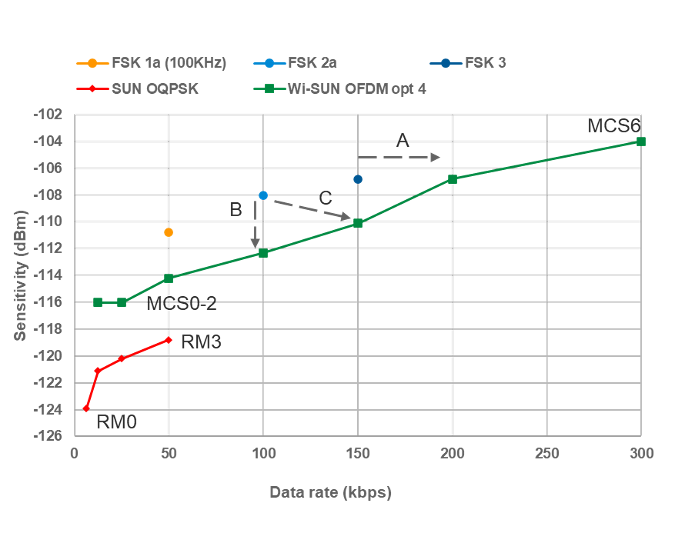
The chart above shows all the PHYs that we have discussed at length. When you look at the OFDM (Option 4) vs FSK use case for these regions, three conclusions can be drawn (shown above as A, B, and C). When we look at case A, you can see that with a similar receive sensitivity or range, OFDM can offer a 30 to 50% increase in data rate. When we look at case B, you can get a roughly 4 dB sensitivity improvement at the same data rate resulting in a significant point-topoint range extension. And lastly, case C combines both A and B into a single example. When looking at FSK 2a, OFDM Option 4 MCS 4 can give a 50% data rate improvement and a 2 dB sensitivity improvement resulting in both higher throughput and increased range.
Taking it a step further, you can see the huge range of improvement that can be gained by using the SUN O-QPSK PHY when compared to both FSK and OFDM. Looking at just the 50 kbps data rate, SUN O-QPSK provides a 5 dB improvement over OFDM and an 8 dB improvement over FSK which would have a major impact on point-to-point range for these low data rate applications. In this real-world example, you can see how the flexibility that is provided by networks like Wi-SUN that take advantage of this multi-PHY architecture can help optimize networks without complicating things at a stack level and allowing these devices to interact with one another with minimal added overhead.
EU-IN: 200KHz channel spacing
Performance Comparison: North America Example
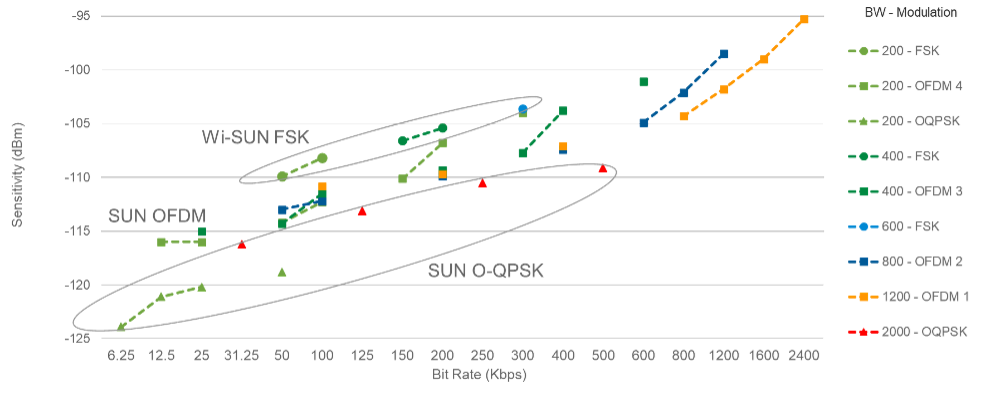
The chart above shows implementations of all 3 PHYs to show the potential performance tradeoffs between them.
While this plot is more complicated, the conclusions that can be drawn from it are straightforward.
- OFDM is a very flexible PHY with multiple data rates available in a single-channel spacing option.
- For a given FSK PHY, you can increase the data rate with OFDM for the same range and bandwidth.
- SUN O-QPSK brings a significant range improvement over both FSK and OFDM within the data rates and channel spacing that it supports.
In North America, developers are truly allowed to optimize their networks based on need and are given the flexibility to choose the PHY, channel spacing, and data rate that best meets their application with very little compromise.
Conclusion
Historically, the limited resources and proprietary nature of sub-GHz based networks have required major compromise in performance, but the emergence of standards-based options has opened up the realm of possibilities. The inclusion of multiple PHY options within a single network allows for the selection of the best option for a given application rather than trying to fit all applications within a small performance window. This flexibility enables greater scalability and interoperability as use cases in the IoT expand.
The inclusion of more advanced modulation schemes like OFDM, allows for developers to make compromises on data rate, power consumption, and performance in real-time based on the needs of the device and network rather than being forced into a single scheme. When this is combined with the added flexibility that is provided by mode switch or concurrent detection features, devices can even change between PHYs in real time to ease the introduction of critical functionality, like OTA upgrades, that have never really been an option for these low bandwidth, low data rate networks.
For developers who wish to leverage defined protocols and ensure interoperability, the emergence of protocols, like Wi-SUN, that leverage the IEEE 802.15.4g standard make that task simpler. These protocols and the certification processes that they have put in place provide a mechanism for users to leverage already deployed networks and improve the overall user experience.
For developers who are looking for a proprietary solution, IEEE 802.15.4g provides a defined set of PHYs that they can use as the basis of their protocols. This allows SoC providers to develop tools and provide a level of support that is not typically seen in truly proprietary deployments. No longer do device manufacturers have to take on the burden of fully defining a protocol from the ground up, they can focus on the details that allow them to set their product apart in the increasingly crowded connected device space.