



Introduction
Our communities are undergoing a fundamental energy transformation, driven by grid modernization, distributed energy resources (DER), electric vehicle (EV) infrastructure, and the expansion of smart city services. These applications are bringing transformative improvements, but they also demand outdoor IoT networks that can scale from hundreds to thousands of devices while maintaining consistent reliability, low latency, and predictable performance.
Wi-SUN FAN (Field Area Network) has emerged as a leading standards-based IPv6 mesh technology purpose-built for these large-scale deployments. However, real-world performance remains the critical question.
At the scale needed for these use cases, connectivity alone is not enough. Network performance, formation and recovery time, latency, and over-the-air (OTA) efficiency directly impact operational costs, service availability, and customer satisfaction.
In this whitepaper, we discuss Wi-SUN FAN 1.1 as a leading connectivity solution for large-scale utility and smart city networks, delivering reliable, low-latency communication and efficient over-the-air updates in dense, multi-hop deployments.
We also explore how Silicon Labs’ SoCs and highly optimized Wi-SUN stack are helping these networks achieve superior scalability, fast self-healing, and consistent performance under real-world conditions. These capabilities are rigorously validated through Silicon Labs’ Large Test Network (LTN), a deployment of over 1,000 nodes, providing compelling proof of performance on scale.
Introduction
Our communities are undergoing a fundamental energy transformation, driven by grid modernization, distributed energy resources (DER), electric vehicle (EV) infrastructure, and the expansion of smart city services. These applications are bringing transformative improvements, but they also demand outdoor IoT networks that can scale from hundreds to thousands of devices while maintaining consistent reliability, low latency, and predictable performance.
Wi-SUN FAN (Field Area Network) has emerged as a leading standards-based IPv6 mesh technology purpose-built for these large-scale deployments. However, real-world performance remains the critical question.
At the scale needed for these use cases, connectivity alone is not enough. Network performance, formation and recovery time, latency, and over-the-air (OTA) efficiency directly impact operational costs, service availability, and customer satisfaction.
In this whitepaper, we discuss Wi-SUN FAN 1.1 as a leading connectivity solution for large-scale utility and smart city networks, delivering reliable, low-latency communication and efficient over-the-air updates in dense, multi-hop deployments.
We also explore how Silicon Labs’ SoCs and highly optimized Wi-SUN stack are helping these networks achieve superior scalability, fast self-healing, and consistent performance under real-world conditions. These capabilities are rigorously validated through Silicon Labs’ Large Test Network (LTN), a deployment of over 1,000 nodes, providing compelling proof of performance on scale.
1. Wi-SUN FAN 1.1 Protocol Overview and Performance
1.1 Architecture Overview
A Wi-SUN network is structured around a border router, which serves as the gateway between the field network and backend systems. Router nodes form the backbone of the mesh, forwarding traffic and extending coverage across large geographic areas. Low-energy (LE) leaf nodes, such as battery-powered meters and sensors, connect to the backbone of the mesh.
Wi-SUN FAN 1.0 supports large-scale outdoor mesh networks with thousands of nodes per PAN. It’s based on IEEE 802.15.4g/e sub-GHz PHY, IPv6 networking (6LoWPAN), RPL-based routing, frequency hopping (FHSS), CSMA/CA channel access, and a multi hop mesh topology optimized for wide-area coverage.
FAN 1.0 deployments have demonstrated high link reliability, strong interference resilience, long-range operation, and secure authentication. However, as networks scale, system-level performance metrics become critical beyond connectivity.
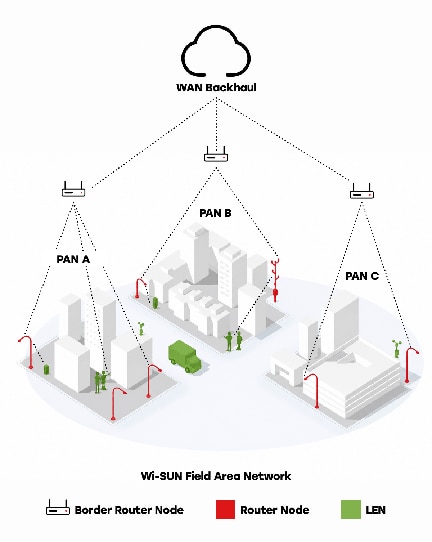
Fig 1: A Typical Wi-SUN FAN Architecture
1.2 Wi-SUN FAN 1.1 Enhancements
Wi-SUN FAN 1.1 builds upon FAN 1.0 and introduces two major profiles.
First, the High Performance (HP) profile enables OFDM PHY up to 2.4 Mbps and supports mode switching between FSK to FSK and FSK to OFDM. This shortens on-air time and reduces congestion, as well as enabling faster OTA updates and better support for high-telemetry applications.
The Low Energy (LE) profile optimizes MAC parameters, enabling the device to be sleeping most of the time. This is important for battery-powered devices with years or even decades-long service lives.
1.3 Why Existing Connectivity Approaches Fall Short
Traditional connectivity technologies often struggle to meet the combined requirements of scale, reliability, and control in outdoor IoT environments. Cellular solutions provide wide-area coverage but introduce recurring operational costs and dependency on public network infrastructure. They also limit the ability of utilities to fully control network behavior and performance.
Low-power wide-area network (LPWAN) technologies are optimized for long-range communication but are typically constrained in downlink capacity and bidirectional communication efficiency. This makes large-scale firmware updates and control operations challenging.
Legacy proprietary RF mesh solutions can provide local control but often lack the scalability, interoperability, and efficiency required for modern deployments. As networks grow, these systems may exhibit slow recovery, inefficient routing, and limited flexibility. Wi-SUN FAN addresses these limitations through an open, standards based IPv6 mesh architecture designed specifically for utility-grade scale and performance.
1.4 Performance Dimensions in Large Mesh Networks
As network size increases, several key metrics begin to dominate overall system performance, including network formation time, re-formation time, transmit success rate, latency (both one-way and round-trip), and OTA update duration. These performance dimensions play a critical role in determining the efficiency and scalability of the network. In turn, each of these metrics has a direct impact on operational availability, maintenance cost, customer satisfaction, and overall service level agreement (SLA) compliance.
2. Silicon Labs’ Wi-SUN Stack Differentiation
Silicon Labs has optimized its Wi-SUN stack, which comes included with SoCs, to address the challenges of large-scale deployments. The implementation focuses on stability, scalability, and rapid recovery under real-world conditions.
Key enhancements include fast parent reselection mechanisms that enable nodes to quickly identify optimal routing paths, as well as optimized RPL metrics that improve routing efficiency and stability. Controlled trickle timer behavior reduces unnecessary traffic control, while PAN defect detection and preferred PAN selection improve network robustness.
Additional features such as Last Gasp and First Breath Mechanisms further enhance resilience by enabling reliable outage notification and rapid rejoining following power restoration. These optimizations collectively contribute to predictable network behavior, even in dense environments.
2.1 Small, Medium, and Large Profiles for Wi-SUN Networks
To address varying performance and scalability requirements, Wi-SUN networks can be categorized into three operational profiles - small, medium, and large, each with distinct optimization priorities, traffic characteristics, and infrastructure needs.
Small-scale networks (tens to a few hundred nodes) are typically used in localized deployments such as campus lighting, building automation, or EV charging infrastructure. The primary focus is on fast network formation and rapid reconnection. LTN results show quick convergence with minimal tail effects, enabling near immediate operational readiness. In such “small” network configurations, asynchronous traffic is kept high to facilitate network advertisement and fast node connections. A single Border Router is typically sufficient for up to ~100 to 250 nodes, which allows the use of an SoC Border Router, making this profile ideal for responsive, easy-to-deploy systems.
Medium-scale networks (a few hundred to ~1000 nodes) represent the most common production deployments, including advanced metering infrastructure (AMI) and smart city infrastructure. LTN validation shows predictable formation and fast recovery for most nodes, with limited convergence tail. Latency scales with hop count but remains within acceptable bounds. These networks require a balanced approach to traffic and stability. A typical deployment uses one Border Router per PAN for ~250 to 500 nodes, with segmentation into multiple PANs improving OTA efficiency, operational predictability, and robustness.
Large-scale networks (hundreds to a few thousand nodes per PAN) are characteristic of full AMI and grid deployments, where scalability and stability dominate. LTN results show that while networks scale beyond 1,000 nodes, performance is driven by reconnection dynamics, traffic control, OTA duration, and multi-hop latency. Approximately 90% of nodes reconnect quickly, while deeper nodes define the convergence tail. These networks require controlled joining behavior and quieter traffic patterns. A typical guideline is one Border Router per ~500 to 1,000 nodes; however, beyond this range, deploying multiple PANs with additional BRs is recommended to improve OTA time, fault isolation, and recovery predictability.
3. Large In-house Wi-SUN Test Network (LTN) Infrastructure
Silicon Labs proudly maintains a one-of-a-kind, extensive in-house sub-GHz Wi-SUN FAN test network, committed to thorough and rigorous testing. Building on our previous implementations of large Zigbee mesh networks, along with hundreds of Bluetooth Low Energy (LE) nodes for ESL testing, we’ve gained invaluable insights that have shaped our current Wi-SUN test network. Featuring 1,000+ sub-GHz mesh nodes, the network showcases our commitment to advancing wireless communication technologies.
The LTN enables controlled evaluation of network formation, recovery behavior, latency, and OTA performance across different network sizes and configurations. It provides a unique platform for understanding how Wi-SUN networks behave on a scale and for validating optimization strategies.
The LTN is used to validate performance in real-world conditions. It supports PAN sizes ranging from a few nodes to 1,000+ nodes in real RF environments with multi-hop topologies, configurable channel sets, synchronized power cycling, automated logging, and OTA capability.
Each node is set to transmit a 500B UDP packet to the BR every 15 minutes. This allows us to get great insight into the transmit success rate, which is typically 99.95%.
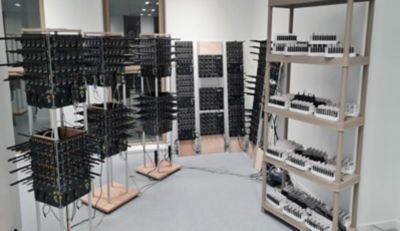
Fig 2: Silicon Labs’ In-house Large Test Network (LTN)
4. Network Formation and Re-Formation Performance
Reformation is critical. In scenarios where all nodes power-cycle simultaneously, routing must be rebuilt. Observed behavior shows 90% of nodes reconnect significantly faster than the remaining 10%, which are influenced by topology depth and control mechanisms.
Reconnection procedure:
Power cycle all nodes while the Border Router stays alive
Node traffic:
Once connected, each node sends a ~500B UDP packet to the BR every 15 minutes.
Network initial formation is usually less critical, but it’s a good metric to capture to reflect behavior in the event of a BR replacement after failure.
Connection procedure:
a) Power down all nodes
b) Power down the border router
c) Restart the border router with the new PAN ID
d) Power up all nodes
Testing within LTN demonstrates that Wi-SUN FAN networks exhibit strong self healing characteristics. Initial network formation typically follows a predictable pattern with linear growth initially, exponential scaling as parent nodes become available, and a tail phase as remaining nodes join. This demonstrates that most of the network becomes operational well before full convergence.
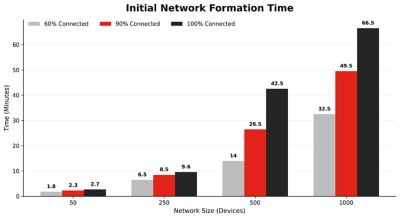
Fig 3: Initial Connection Times
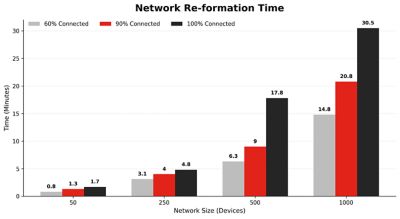
Fig 4: Network Reformation Times
Takeaways
- Self-organizing recovery: The network automatically reconnected 1000 nodes without intervention
- Operational resilience: Rapid recovery minimizes downtime after power loss or maintenance cycles
5. Latency Performance
There are two kinds of latency performance metrics:
- One-way latency matches the configuration case where the BR would set a parameter in a device
- Two-way latency (round-trip) matches the case of a BR requesting data from a device
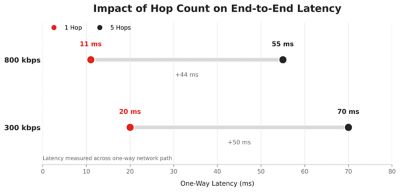
Fig 5: One Way Latency vs Hop Count
Measurement procedure for round-trip latency:
CoAP requests are sent sequentially to all nodes. Waiting for the response of one node to send the request to the next one (3-second timeout). Non-responsive nodes get a second request. Note: the measurement is made on top of usual traffic, where each node sends a 500B packet to the BR every 15 minutes.
Latency depends on hop count, traffic load, backoff configuration, RPL path cost, and parent stability. Multi-hop mesh introduces cumulative forwarding delay.
Response time:
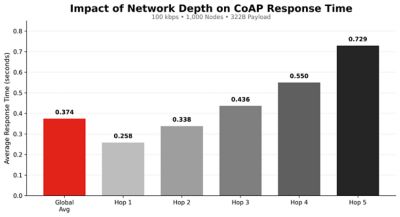
Fig 5: Response time
Takeaways
- LTN measurements show latency scales approximately linearly with hop depth. Even at larger scales, latency remains suitable for AMI, lighting, and grid telemetry applications.
- For ultra-low latency, optimization includes reducing PAN size, tuning RPL, and using HP backbone configurations.
6. OTA: Over-The-Air Firmware Update - Delivery Time
Firmware: Compressed image of 380kB
Metric: Only delivery time is reported; node reboot schedule and strategy are not addressed here. OTA updates across large networks (1.000 to 2,000 nodes) are constrained by airtime and multi-hop behavior.
Actually, two approaches have been implemented for OTA firmware update:
- Unicast OTA, in which the firmware image is transmitted to a single node.
- Broadcast OTA, where the same image is transmitted to all nodes using the dedicated broadcast slots
OTA delivery scenario: Unicast with TFTP (Trivial File Transfer Protocol)
Unicast OTA: the performance reported below is measured using the TFTP (Trivial File Transfer Protocol) delivery method, with a 100 kbps base PHY.
The performance is reliable but sequential and time-intensive. The HP profile further improves OTA performance through higher PHY rates.
Broadcast OTA: enables parallel distribution, reducing airtime per node and total update duration. This becomes essential for networks with hundreds of nodes and is particularly suitable if a unique image is to be delivered to all.
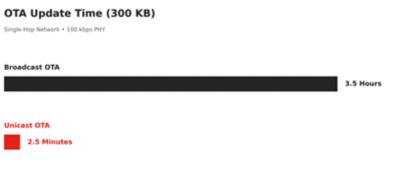
Fig. 6: Unicast / Broadcast OTA times
Takeaways
- Secure, reliable OTA updates: Proven ability to manage firmware across multi-hop mesh networks
- Operational efficiency: Reduces maintenance time and cost for large-scale smart meter or IoT deployments
- Field readiness: Supports long-life deployments where OTA is critical for feature updates and security patches
7. Case Study on India Smart Energy Meter SLA Requirements
India represents one of the largest and most demanding AMI deployment environments globally, driven by national programs such as the Revamped Distribution Sector Scheme (RDSS). These deployments impose stringent SLA requirements.
7.1 India AMI SLA Requirements Overview
Typical SLA requirements across Indian utility AMI deployments include:
- Network Availability: ≥ 99.5%
- Meter Read Success Rate: ≥ 98 - 99%
- On-Demand Read / Command Response Time: ≤ 5 - 10 seconds
- Reconnect / Rejoin Time: Rapid recovery (seconds to minutes after outage)
- Event/Alarm Latency: ≤ 5 seconds
- Network Recovery Time: Rapid recovery for the majority of nodes, full convergence within operational limits
- OTA/Firmware Upgrade Completion: Within defined maintenance windows
7.2 Wi-SUN FAN 1.1 Performance Alignment with SLA Requirements
Silicon Labs’ Wi-SUN FAN 1.1 stack has been validated to meet India AMI SLA requirements, based on Large Test Network (LTN) testing with 1000+ nodes under real RF conditions. The results demonstrate compliance across key SLA dimensions, including Connect/Reconnect times, reliability, latency, OTA performance, and scalability.
Silicon Labs’ Large Test Network (LTN), with 1000+ nodes in real RF conditions, validates Wi-SUN FAN performance against these requirements.
Availability and Reliability
Wi-SUN FAN demonstrates strong self-healing behavior, with ~90% of nodes reconnecting rapidly after disruption and full network convergence following predictably. Combined with Border Router redundancy and PAN segmentation (Section 7.2), this supports ≥99.5% availability targets.
Meter Read Success Rate
Stable multi-hop routing and sustained periodic traffic in LTN testing demonstrate reliable uplink performance consistent with ≥98–99% successful meter reads at scale.
Latency Performance
Measured latency (Section 5) remains within SLA bounds, with response times consistent with ≤5–10 seconds for command/response operations in large multi-hop networks.
Network Recovery
Re-formation testing confirms that the majority of nodes return to operation quickly following power events, supporting utility requirements for rapid service restoration.
OTA Performance
Broadcast OTA and FAN 1.1 HP profile significantly reduce firmware distribution time (Section 6), enabling upgrades within practical maintenance windows for large deployments.
Scalability
Validated operation at 1000+ nodes per PAN demonstrates readiness for dense AMI deployments, with deployment guidelines supporting further scale through segmentation.
7.3 Compliance Statement
Based on measured results from Silicon Labs’ Large Test Network, Silicon Labs’ Wi-SUN FAN 1.1 stack meets and is validated against key SLA requirements for India smart meter deployments, including availability, latency, recovery, OTA performance, and scalability for PANs up to around 200 nodes.
8. Wi-SUN Utility Deployments: Backup Border Router and High Availability Requirements
For utility-grade Wi-SUN deployments, BR resiliency is a critical design consideration to ensure continuous network operation, minimize service disruption, and meet stringent SLA requirements. As the aggregation and control point of the PAN, the BR represents a potential single point of failure if redundancy is not implemented.
The solution shall support Border Router redundancy mechanisms to enable high availability under fault conditions, including hardware failure, backhaul disruption, or planned maintenance events.
For medium- and large-scale deployments, architecture should support network segmentation across multiple PANs, each with an independent BR, to provide inherent fault isolation and limit the impact of localized failures. This approach reduces recovery domains and enhances overall system robustness.
The system shall enable rapid network recovery and re-attachment in the event of BR failover. Silicon Labs LTN demonstrates that most nodes can reconnect quickly following network disruption, supporting recovery objectives aligned with utility SLAs, while minimizing the operational impact of outages.
At a minimum, deployments should incorporate a backup BR strategy. Wi-SUN is designed to be self-healing by nature, and in case of BR failure, the nodes automatically move to the second BR. On top of this, Silicon Labs has implemented preferred PAN and PAN defect features that allow:
- Good balance of nodes between PANs
- Faster switch to the second BR in case of BR failure
- Restore initial PANs when the BR that failed is back tin operation
Overall, a combination of BR-level redundancy and PAN-level segmentation is recommended to meet utility requirements for high availability, fault tolerance, and predictable recovery performance in large-scale field deployments.
9. Security Considerations for Smart City Networks
Security is a critical aspect of utility and smart city networks. Wi-SUN FAN incorporates strong authentication mechanisms, secure device onboarding, and end-to-end encryption to protect data and network integrity.
Secure OTA processes ensure that firmware updates can be delivered safely, preserving the trustworthiness of devices over long deployment lifecycles.
Key security standards followed by Wi-SUN FAN include:
- Authentication: IEEE 802.1X with EAP-TLS
- Device Identity: IEEE 802.1AR (Dev ID certificates)
- Frame Security: IEEE 802.15.4 with AES-CCM-128
- Key Management: Derived via 802.1X/EAP-TLS (PMK, PTK, GTK)
- Trust Model: Public Key Infrastructure (PKI)
- Network Layer: IPv6 over 6LoWPAN with secure routing (RPL)
Silicon Labs Secure Vault™ adds a hardware-based root of trust to Wi-SUN devices, ensuring each node has a unique, tamper-proof identity. It securely stores and protects encryption keys, preventing unauthorized access or cloning of devices.
Secure Vault also enables secure boot and authenticated OTA updates, ensuring only trusted firmware runs on the device. Additionally, it protects against physical and software attacks, strengthening overall network integrity.
Together, this enhances Wi-SUN mesh security beyond protocol-level protection.
10. Conclusion and Wi-SUN FAN 1.1 Outlook for Large-Scale Smart City Deployments
Wi-SUN FAN 1.1 represents a significant advancement in connectivity for large-scale outdoor IoT networks. When combined with Silicon Labs’ optimized stack and hardware platform, it delivers predictable performance, rapid recovery, and efficient operation across thousands of nodes.
Validated through real-world testing in the Large Test Network, this solution provides the reliability and scalability required for next-generation utility and smart city deployments.
As utilities and cities continue to evolve, network requirements will expand to support new applications such as Advanced Grid automation (AMI2.0), EV infrastructure, and increased DER integration. Wi-SUN FAN 1.1 provides a scalable foundation for these future needs.
Silicon Labs’ platform supports ongoing innovation through firmware updates and continued standards evolution, ensuring long-term adaptability and investment protection.