



Our Z-Wave SoC and Module Selector Guide provides you with a quick, comparative overview of our portfolio to help you select the ideal SoC or module for your next project.
This Z-Wave Selector Guide explores the Z-Wave wireless communication standard and its pivotal role in smart home technology. It delves into the key features of Z-Wave, including its use of Sub-GHz frequency bands for reduced interference, mesh networking capabilities, and emphasis on interoperability among devices from different manufacturers. The paper also provides an in-depth look at Silicon Labs' Z-Wave solutions, covering both hardware and software components for controllers and end devices. Explore the differences between Z-Wave Mesh and Z-Wave Long Range (LR) technologies, including their respective advantages in different smart home applications. We take a look at Z-Wave's robust security features, including the S2 framework and Silicon Labs' Secure Vault™ technology.
What is Z-Wave?
Z-Wave is a prominent wireless communication standard designed specifically for smart home applications. It enables various smart home devices, such as lights, door locks, security systems, climate controls, and window blinds to communicate and work together seamlessly. This interoperability facilitates the creation of a cohesive and intuitive smart home ecosystem.
Z-Wave technology uses Sub-GHz frequency bands, which are less congested compared to the 2.4 GHz and 5 GHz bands commonly used by other home automation standards. This significantly reduces the chances of interference, enhancing the reliability and robustness of Z-Wave networks. It incorporates secure and reliable two-way communication through message acknowledgment and mesh networking, ensuring that commands are executed as intended.
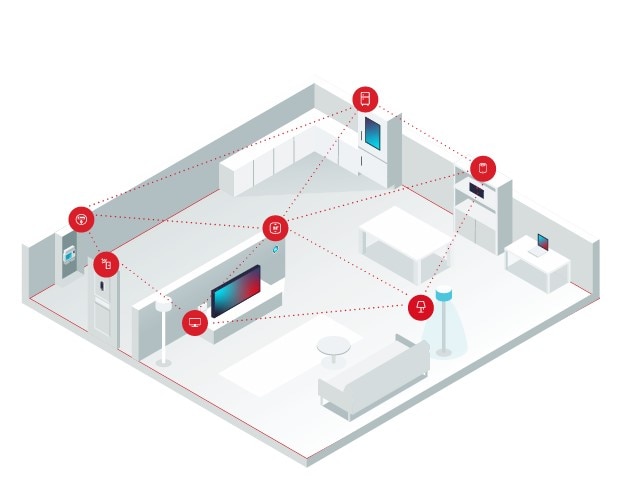
How Does Z-Wave Work?
Z-Wave is, by far, the most widely used wireless protocol for home automation. It uses simple, reliable, low-power radio waves that easily travel through walls, floors and cabinets, without interference from the other wireless devices you might have in your home. Z-Wave can be added to almost anything electronic, even devices that you wouldn’t ordinarily think of as “intelligent,” such as appliances, window shades, thermostats, and lights.
Z-Wave offers integrators and system designers a world of business opportunities, along with the products and training to make those opportunities pay dividends for both hosts and clients. Now, integrators can easily deliver all the hot applications that customers are asking for, including remote home and business management, energy conservation, connected solutions for independent aging, real estate and property control, and more. All of this with no new wiring required and the confidence that comes with an interoperable standard that works seamlessly between brands.
Z-Wave Long Range is an evolutionary wireless technology that brings forth a new era of connectivity, extending the reach of the Z-Wave dynasty by leveraging existing modulations that can provide greater range (via DSSS OQPSK) while meeting regulatory requirements. Z-Wave LR offers a significant advantage, as it is designed to provide extended wireless coverage, increased scalability, optimized battery life, and robust security for IoT networks. It is designed to extend the range of Z-Wave networks while maintaining power efficiency, a critical requirement for smart home devices that often rely on battery power. In addition, the Z-Wave 800 series, which supports Z-Wave LR, has been further optimized for low power consumption, enabling devices to run for up to 10 years on a coin-cell battery
Key Features

Sub-GHz Frequency: Z-Wave uses a sub-GHz frequency band, avoiding the more congested 2.4 GHz and 5 GHz bands. This choice minimizes interference from other wireless devices in and around the home, providing a more reliable communication channel for home automation devices.

Secure and Reliable Communication: Z-Wave ensures secure and reliable two-way communication through message acknowledgment and mesh networking. Each message sent over a Z-Wave network is acknowledged, ensuring the sender knows the message has been received. If a message is not acknowledged, the network can automatically retry sending the message, enhancing reliability.

Mesh Networking: In a Z-Wave mesh network, devices (nodes) can communicate directly with each other or relay messages through other devices to reach nodes that are out of direct range. This increases the network’s range and reliability, as messages can find multiple paths to their destination.

Z-Wave (LR): Supports a star network topology. In a star network, all nodes (devices) connect directly to a central hub or gateway. This differs from a mesh network, where nodes can connect to multiple other nodes, not just a central hub. However, while individual Z-Wave LR devices operate in a star network, they can still be part of a larger more extensive Z-Wave mesh network.

Inclusion and Exclusion: The Z-Wave protocol supports the addition (inclusion) and removal (exclusion) of devices from the network. This allows for flexible configuration and reconfiguration of the smart home setup as devices are added, moved, or removed.

Interoperability: A key aspect of Z-Wave is its emphasis on interoperability. Z-Wave devices are required to undergo a certification process to ensure they can work seamlessly with other Z-Wave devices, even those from different manufacturers. This is achieved through application layer interoperability, meaning all devices speak the same “language” or use the same commands and protocols.
Silicon Labs Z-Wave Solution
The Silicon Labs Z-Wave solution is an end-to-end solution with software and hardware building blocks for both controllers and end devices to create a full smart home IoT system. The Z-Wave software gives you the foundational features required in the Z-Wave Specification and enables you to focus on your application without the need to be a protocol expert.
Z-Wave is designed to meet the demands of the future smart home, hospitality, and MDUs, where increasing needs for more sensors and battery-operated devices require both long-range and low power. Our sub-GHz Z-Wave solutions offer best-in-class security, Smart Start provisioning, battery life of up to 10 years, full home and yard coverage, customer product-level interoperability, and backward compatibility.

Smart Home

Multi-Dwelling Units

Hospitality
Broad Ecosystem
Hundreds of Z-wave Alliance members
Sub GHz
Penetrates walls, long range, less interference
All Interoperable
Thousands of certified products & 100% interoperable
Mesh & Star
Large network coverage Robust
Easy to Install
SmartStart error free installation
Secure
S2 security framework Secure Vault™
Low Power
Up to 10 years on a Coin cell
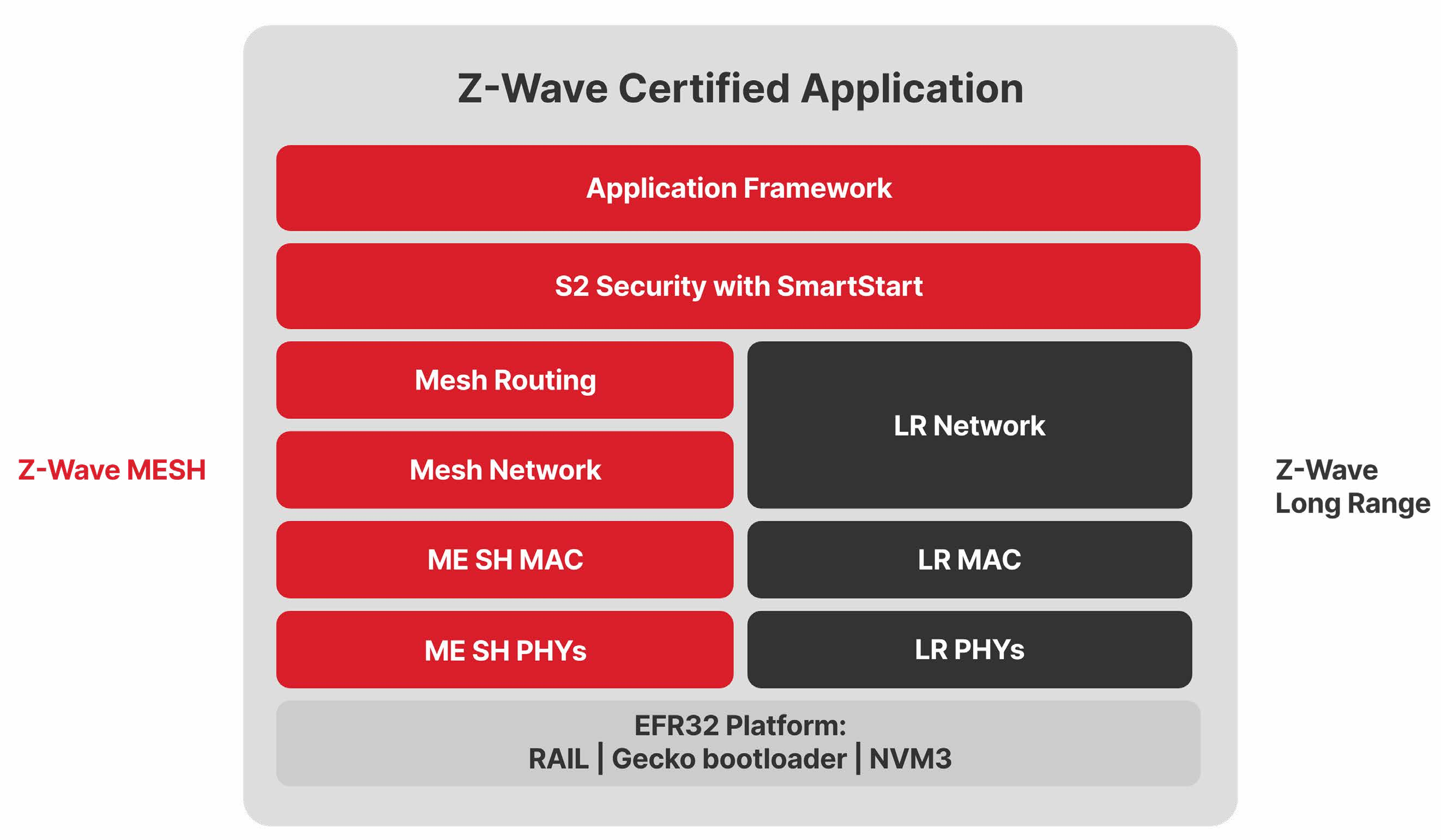
Z-Wave End Device Software
The Z-Wave End Device software from Silicon Labs enables end devices such as security sensors, door locks, light switches/bulbs, and many more to benefit from the pre-certified Z-Wave applications, all certified under the latest certification program from the Z-Wave Alliance. For more custom device applications you can leverage the Z-Wave Application Framework.
The complete suite of Z-Wave-certified hardware and software building blocks enables system solutions for end device makers and controller/gateway companies to build Z-Wave-powered smart home products and enjoy the benefits of taking part in the Z-Wave Ecosystem.
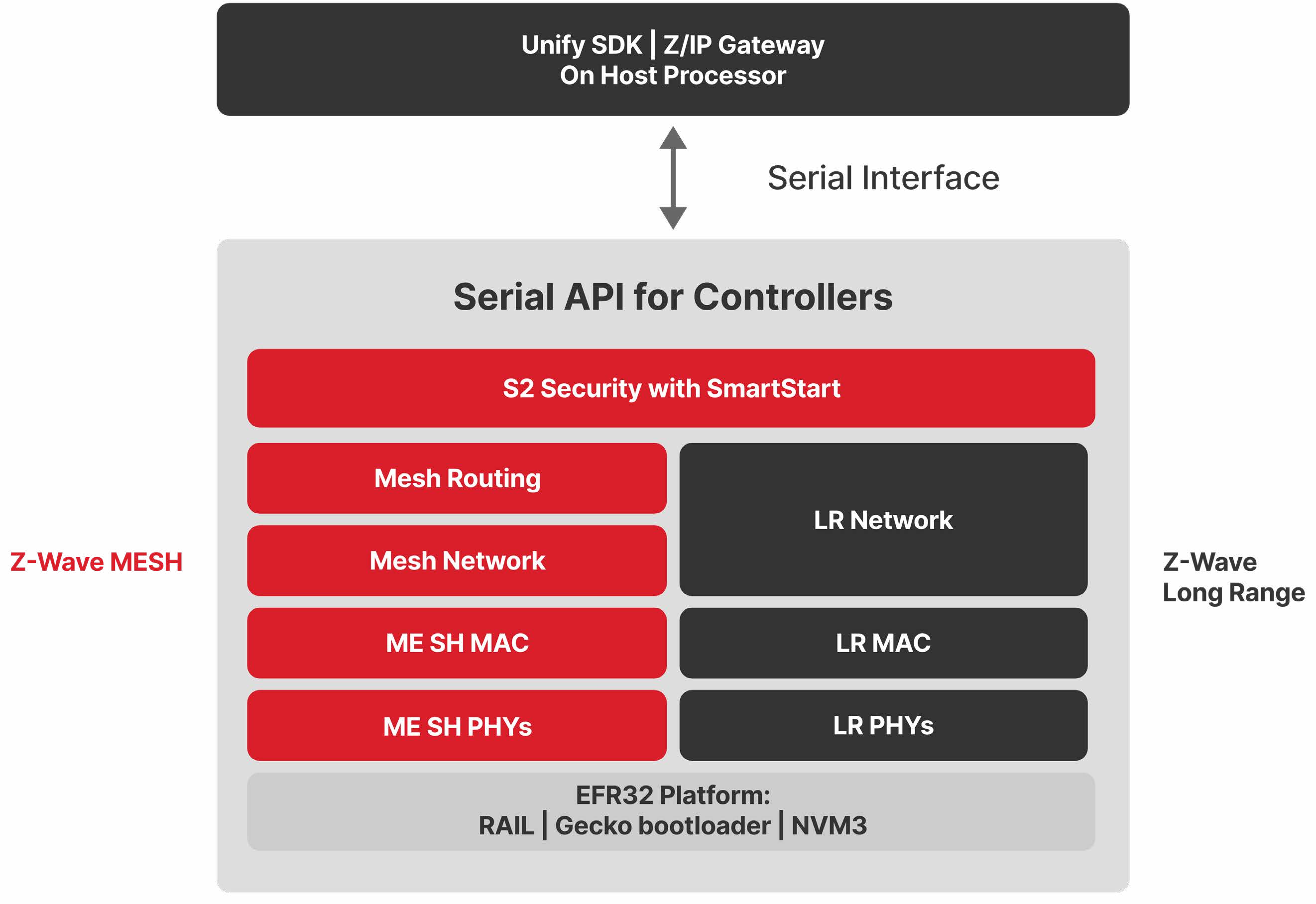
Z-Wave Controller Software
The Z-Wave Controller software from Silicon Labs enables faster time to market, as it handles all connectivity and protocol details, allowing you to focus on your application software and cloud connection. The Z-Wave Controller solution with Unify SDK provides features such as easy and secure commissioning, network maintenance, a mailbox for battery devices, and more, ensuring your controller product is in compliance with the required functionality from the Z-Wave Alliance Specification. The controller solution is pre-certified under the latest Z-Wave certification program from the Z-Wave Alliance and distributed as a source code via GitHub. The pre-certified Z/IP Gateway option is also still available and distributed as a source code, but it is in maintenance mode
Why Choose Silicon Labs for Your Z-Wave
Silicon Labs Z-Wave wireless solutions are end-to-end solutions with software and hardware building blocks for both controllers and end devices for home security and smart home devices, including door locks, thermostats, shades, switches, and sensors. Z-Wave software provides the foundational features required in the Z-Wave specification and enables you to focus on your application without needing to be a protocol expert.
The ZG28 is an ideal dual band sub-GHz + 2.4 GHz SoC. The low-power, high-performance SoC features 1024 kB of Flash, 256 kB, and up to 49 GPIO to enable advanced Z-Wave applications.
- Ideal for smart home, hospitality, MDU, smart cities
- Highest level of IoT security
- Secure Vault™
- Dual band/Bluetooth Low Energy
- Z-Wave, Amazon Sidewalk, Wi-SUN and Proprietary
Based on the EFR32ZG23 SoC, the ZGM230S delivers robust RF performance, long-range, industry leading security features, and low-current consumption in a 6.5 x 6.5 mm package.
- Ideal for smart home, security, lighting, and building automation
- Highest level of IoT security
- Secure Vault™ High
The ZG23 is an optimized low-power, high-performance, sub-GHz SoC that provides up to 512 kB of Flash and 64 kB of RAM for Z-Wave Mesh and Z-Wave Long Range (LR).
- Ideal for smart home, hospitality, MDU, and smart cities
- Highest level of IoT security
- Secure Vault™
- Z-Wave, Amazon Sidewalk, Wi-SUN and Proprietary
Comparing Z-Wave Mesh and Z- Wave LR (Star)
| Z-Wave Mesh | Z-Wave Long Range (LR) | |
|---|---|---|
| PHY Modulation | FSK/GFSK | DSSS OQPSK |
| PHY Speed | 9.6/40/100 kbps | 100 kbps |
| PHY Frequency in US | 908.42/916 MHz | 912/920 MHz |
| PHY Max Output Power* | *1 dBm(FCC), +14 dBm(ETSI) | Spec will allow up to +30 dBm(FCC) |
| PHY Output Power Control | No | Yes |
| MAC LBT | Yes | Same as Z-Wave |
| MAC Random Back Off | Yes | Same as Z-Wave |
| MAC Frames | Single, multi, broadcast, beams (1000ms) | Single, multi, broadcast, beams (100ms fragmented) |
| MAC Address Space | 32-bit Home Id, 8-bit Node ID | 32-bit Home Id, 12-bit Node ID |
| NWK | Mesh | Star |
| Routing | Supported | Not Supported |
| Inclusion | NWI and Inclusion controller support | Direct inclusion only |
| SmartStart | QR code | Same as Z-Wave |
| Security | S0, S2 non-Auth, S2 auth, S2 Access | S2 auth, S2 Access |
| Application Framework | Supported | Same as Z-Wave |
| Sample Apps | Supported | Same as Z-Wave |
| IMA | Supported | Same as Z-Wave |
Z-Wave Mesh and Star Network Topology
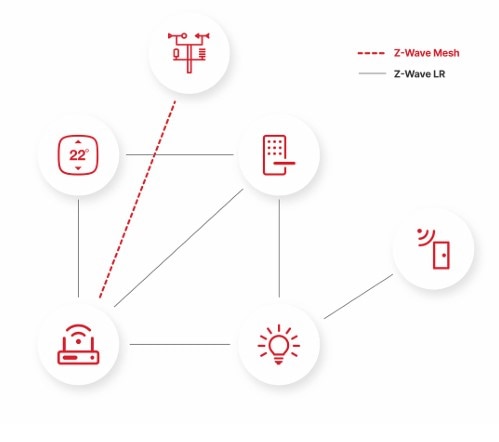
Mesh Network Topology
100 kbps
data rate
+0/14 dBm TX power
400 m
range (4 hops)
Coverage for the smart homemand end of yard
200+ nodes
scalable
8-bit address space
Star Network Topology
100 kbps
data rate
Up to +30 dBm TX power
⁓1.5 Mile
range
Coverage for the whole home, yard and beyond without a repeater
4000 nodes
highly scalable
12-bit address space
How Silicon Labs’ Portfolio isIdeal for Z-Wave Development
We provide smart home IoT device makers with a full range of Z-Wave protocols including Z-Wave 500, Z-Wave 700, Z-Wave LR, and the latest Z-Wave 800.

Hardware
- SoCs and SiP Modules
- Supports all Z-Wave frequencies
- Mesh and Long Range
- Z-Wave and Proprietary support

Stack
- Based on open specification
- Complete solution - PHY to App
- Controller reference design
- Secure Vault™integration

Development Tools
- Packet sniffer and analyzer
- Energy Profiler
- Network controller
- Installation and maintenance tool

Certification
- Ensures interoperability and backwards compatibility
- Z-Wave LR certification is part of Z-Wave Plus V2
- Certification is mandatory for all products
Silicon Labs Z-Wave Comparison
| Product | Range | Data rate | Frequency Band | Network Topology |
|---|---|---|---|---|
| Z-Wave | 100 m | 100 kbps | 915/868 MHz | MESH |
| Z-Wave LR | >1000 m | 100 kbps | 912 MHz | STAR |
Z-Wave Portfolio Comparison
| Z-Wave 800 SoCs | Z-Wave 800 SiP | Z-Wave 800 SoCs | |
|---|---|---|---|
| Family | EFR32ZG23 | ZGM230S | EFR32ZG28 |
| Product Focus | Z-Wave End Devices, Controllers | Z-Wave End Devices, Controllers | Z-Wave End Devices, Controllers |
| Target Applications | End Devices, Controllers | End Devices, Controllers | Z-Wave End Devices, Controllers |
| Frequencies | 868 / 915 MHz (Z-Wave) 110 – 970 MHz (Proprietary) | 868 / 908–920 MHz | 868 / 915 MHz (Z-Wave) 110 – 970 MHz (Proprietary) 2.4 GHz (Bluetooth LE) |
| Core | ARM® Cortex®-M33 w/ TrustZone® Up to 78 MHz | ARM® Cortex®-M33 w/ TrustZone® Up to 39 MHz | ARM® Cortex®-M33 w/ TrustZone® Up to 78 MHz |
| AI/ML Hardware Accelerator | No | No | Yes |
| Max Flash / RAM | Up to 512 kB / 64 kB | 512 kB / 64 kB | 1024 / 256 kB |
| Security Level | Z-Wave S2 Secure Vault™ – Mid Secure Vault™ – High | Z-Wave S2 Secure Vault™ – Mid Secure Vault™ – High | Z-Wave S2 Secure Vault™ – Mid Secure Vault™ – High |
| Max TX Power | +20 dBm | +14 dBm | +20 dBm |
| Antenna | RF Pin | RF Pin | RF Pin |
Development Kits
Kits and Boards
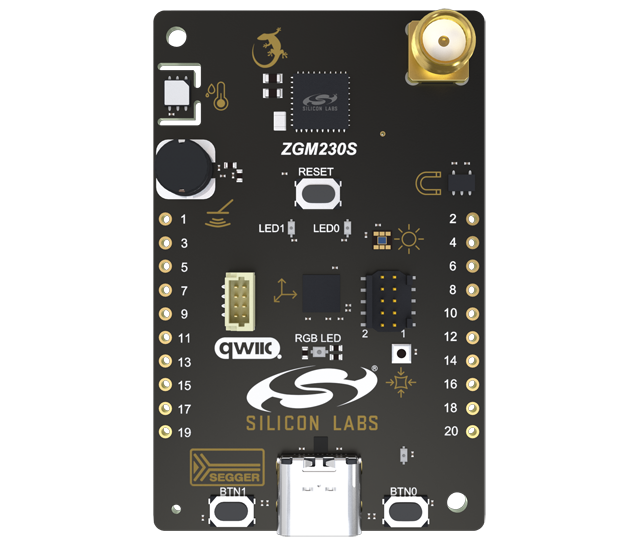
ZGM230-DK2603A
- BRD2603A - ZGM230s +14 dBm Dev Kit Board
- ANT SS900 - 868-915 MHz Antenna
- Sensors
- Temperature and Humidity sensor
- Ambient light sensor
- LESENSE metal detector LC-sensor
- Pressure sensor
- Hall effect sensor
- 9-axis inertial sensor
Radio Boards
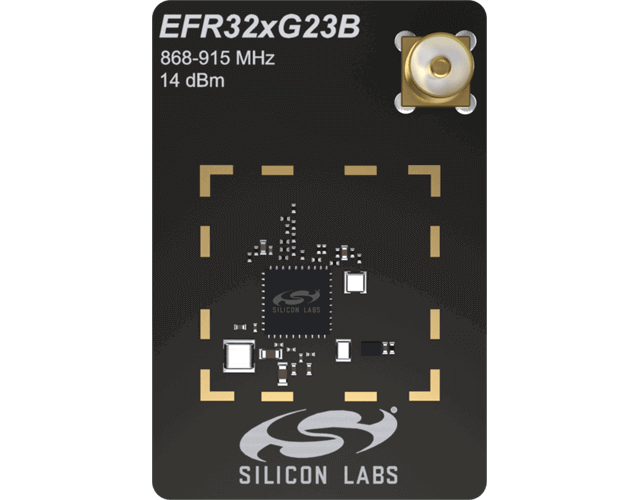
SLWRB4206A
- BRD4206A EFR32ZG14 Z-Wave LR Radio Board
- EFR32 Wireless Gecko Wireless SoC with 256 kB Flash, 32 kB RAM. (EFR32ZG14P231F256GM32)
- SMA antenna connector (863-925 MHz)
- Optional PCB antenna
SLWRB4207A
- • BRD4207A ZGM130S Z-Wave LR Radio Board
- ZGM130S Wireless Gecko SiP Module with 512 kB Flash, 64 kB RAM. Integrated RF matching network, crystals, and decoupling capacitors (ZGM130S037HGN2)
- SMA antenna connector (863-925 MHz)
- Optional PCB antenna
xG28-RB4400C
- 1 x BRD4400C EFR32xG28 2.4 GHz BLE +14 dBm Radio Board
- Requires the WSTK main boards (sold separately)
- Based on the EFR32ZG28B312F1024IM68 2.4 GHz Wireless SoC
- +14 dBm, 1024 kB Flash, 256 kB RAM, QFN68
- SMA Antenna Connector (868-915 MHz)
- Inverted-F PCB antenna, UFL connector (2.4 GHz)
- 8 Mbit low-power serial flash for over-the-air upgrades
xG23-RB4204D
- 1 x BRD4204D EFR32xG23 868-915 MHz +14 dBm Radio Board
- EFR32ZG23 Wireless Gecko Wireless SoC with 512 kB Flash, and 64 kB RAM (EFR32ZG23B010F512IM48)
- Dual band integrated radio transceiver
- 14 dBm output power
- Inverted-F PCB antenna (2.4 GHz)
- SMA antenna connector (868-915 MHz)
- 8 Mbit low-power serial flash for over-the-air upgrades
xG28-RB4401C
- 1 x BRD4401C EFR32xG28 2.4 GHz BLE +20 dBm Radio Board
- Requires the WSTK main boards (sold separately)
- Based on the EFR32ZG28B322F1024IM68 2.4 GHz Wireless SoC
- +20 dBm, 1024 kB Flash, 256 kB RAM, QFN68
- SMA Antenna Connector (868-915 MHz)
- Inverted-F PCB antenna, UFL connector (2.4 GHz)
- 8 Mbit low-power serial flash for over-the-air upgrades
xG23-RB4210A
- 1 x BRD4204D EFR32xG23 868-915 MHz +20 dBm Radio Board
- EFR32ZG23 Wireless Gecko Wireless SoC with 512 kB Flash, and 64 kB RAM (EFR32ZG23B020F512IM48)
- Dual band integrated radio transceiver
- 20 dBm output power
- Inverted-F PCB antenna (2.4 GHz)
- SMA antenna connector (868-915 MHz)
- 8 Mbit low-power serial flash for over-the-air upgrades
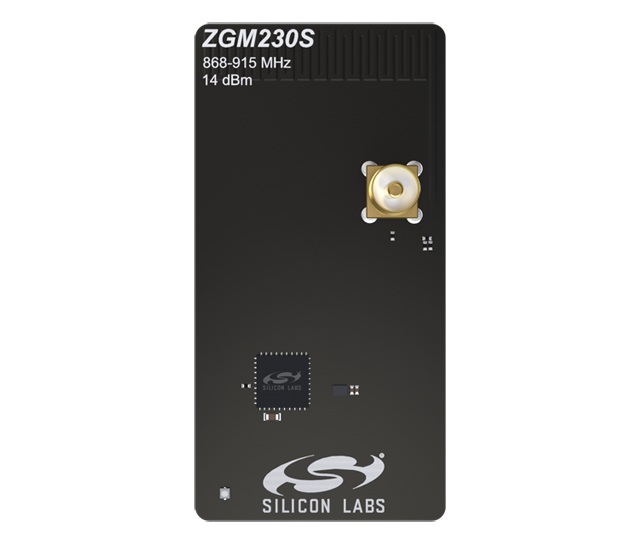
ZGM230-RB4205B
- BRD4205B ZGM230S Z-Wave Radio Board
- ZGM230S Z-Wave SiP Module with512 kB Flash, 64 kB RAM. Integrated RF matching network, crystals, and decoupling capacitors (ZGM230SB27HGN2)
- SMA antenna connector (863-925 MHz)
- Optional PCB antenna
Starter Kit
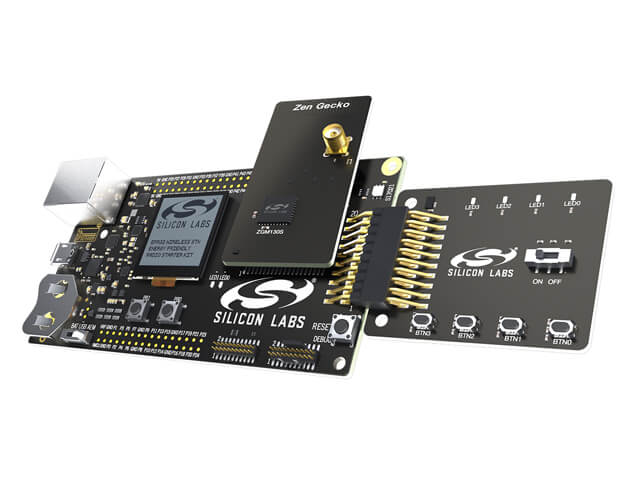
SLWSTK6050C
- 2x BRD4002A Wireless Pro Kit Mainboard
- 2x BRD4207A Z-Wave 700 – ZGM130S Long Range Radio Board
- 1x BRD2603A ZGM230 +14 dBm Dev Kit Board
- 2x BRD8029A Buttons and LED Expansion Board
- 1x UZB-S (ACC-UZB3-S) UZB-S USB stick network sniffer
- 3x 868-915 MHz Antennas
- Z-Wave 700 SiP module Radio Boards to start your development
- Z-Wave Application Framework and pre-certified common end device application code
- Expansion header allows easy expansion and direct integration with Z-Wave Application Framework
- Z-Wave ZGM230-DK2603A to get started with your gateway development
- Pre-built Z/IP* and Z-Ware binaries allow for easy gateway development at your preferred API level
- Supports Z-Wave LR
- Auto-detection for lab evaluation, software development and sample applications
- Z-Wave Application Framework
- Certified Application Code
- Z-Wave Sniffer
- Z-Wave PC Controller
- Energy Profiler
Pro Kits
xG28-PK6024A
- 1x BRD4002A Wireless Starter Kit Mainboard
- 1x xG28-RB4400C +14 dBM 868/915 MHz radio board
- Sub-GHz Antenna
- 1x Flat cable
- 1x 2xAA Battery Holder
- Wi-SUN
- Amazon Sidewalk
- Z-Wave
- Wireless M-BUS
- CONNECT
- Proprietary
- Bluetooth Low Energy
- +14 dBm radio board based on the EFR32FG28 QFN68 wireless SoC
- SMA connector
- Advanced Energy Monitor
- Packet Trace Interface
- Virtual COM port
- SEGGER J-Link on-board debugger
- External device debugging
- Ethernet and USB connectivity
- Low power 128 x 128 pixel
- Memory LCDTFT
- User LEDs / push buttons
- 20-pin 2.54 mm EXP header
- Breakout pads for Wireless SoC I/O
- CR2032 coin cell battery support
xG28-PK6025A
- 1x BRD4002A Wireless Starter Kit Mainboard
- 1x xG28-RB440xB 915 MHz dBm radio board
- Sub-GHz Antenna
- 1x Flat cable
- 1x 2xAA Battery Holder
- Wi-SUN
- Amazon Sidewalk
- Z-Wave
- Wireless M-BUS
- CONNECT
- Proprietary
- Bluetooth Low Energy
- +20 dBm radio board based on the EFR32FG28 QFN68 wireless SoC
- SMA connector
- Advanced Energy Monitor
- Packet Trace Interface
- Virtual COM port
- SEGGER J-Link on-board debugger
- External device debugging
- Ethernet and USB connectivity
- Low power 128 x 128 pixel Memory LCDTFT
- User LEDs / pushbuttons
- 20-pin 2.54 mm EXP header
- Breakout pads for Wireless SoC I/O
- CR2032 coin cell battery support
ZWAVE-PK800B
- 2x BRD4002A Wireless Pro Kit Mainboard
- 1x BRD4204D EFR32ZG23 868-915 MHz 14 dBm Radio Board
- 1x BRD4205B ZGM230S Z-Wave SiP Module Radio Board
- 1x BRD2603A ZGM230 +14 dBm Dev Kit Board
- 2x BRD8029A Button and LEDs
Expansion Board - 3x 868-915MHz Antennas
- Advanced Energy Monitor
- Packet Trace Interface
- Virtual COM port
- SEGGER J-Link on-board debugger
- External device debugging
- Ethernet and USB connectivity
- Silicon Labs Si7021 Relative Humidity and Temperature sensor
- Low power 128 x 128 pixel Memory LCDTFT
- User LEDs / pushbuttons
- 20-pin 2.54 mm EXP header
- Breakout pads for Module I/O
- CR2032 coin cell battery support
Z-Wave Security
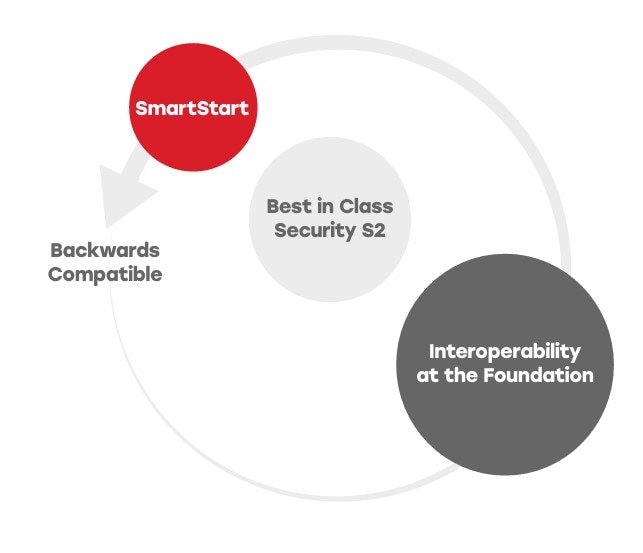
- S2 framework is part of the Z-Wave
protocol security - Secure Vault is Silicon Labs’
additional security fearure
- Out-of-band inclusion
- Elliptic Curve Diffie-Hellman
key changes - Strong AES 128 encryprtion
- Unique/nonce transmissions
- Isolated access control levels
- Secure multicast groups
Protection against
- Hacks and man-in-the-middle
attacks - Inclusion of rogue nodes
- Deciphering of keys
- Sniff & replay and delay attacks
Interoperable
- Z-Wave Alliance-certified devices
work seamlessly with devices from
multiple vendors
Backward Compatible
- Z-Wave 800 series devices are
backward compatible with Z-Wave
700 and 500 Series devices