

Enabling Smarter, More Energy-Efficient Hotels and MDUs Through Z-Wave Long Range
Energy efficiency has become a key differentiator for hotels and multi-dwelling units (MDUs). Rising utility costs, ambitious sustainability goals, and increasing guest expectations are driving property owners to address this by investing in smarter building automation. According to the International Energy Agency's (IEA) Energy Efficiency 2025 report, buildings account for around 30% of global energy demand, making hotels and MDUs two of the largest opportunities for improving operational efficiency.
For developers building next-generation connected buildings, meeting this challenge requires creating scalable energy-management solutions. This starts with secure, low-power endpoints that communicate reliably across an entire property. Z-Wave Long Range provides the wireless foundation to connect these endpoints at scale, enabling hotels and MDUs to sense, connect, and respond intelligently.
Why Energy Management Needs Smarter Endpoints
Energy management is becoming a broader priority across the connected-device ecosystem. In smart homes, for example, Matter Energy Management is expanding how devices can share energy information and coordinate their operation. Hotels and MDUs take this challenge to a different scale, where wireless coverage, endpoint scalability, and long-term operation become critical.
Today's Hotels/MDUs already contain connected thermostats, occupancy sensors, smart locks, lighting controls, and environmental sensors. But many energy-saving opportunities remain untapped because these devices often operate independently rather than as an intelligent system.
Consider a hotel room after a guest checks out. Without occupancy awareness, HVAC systems may continue conditioning an empty room, lights remain on unnecessarily, and housekeeping receives no automated indication that the room is vacant. Similar inefficiencies occur in apartment buildings, where common-area lighting, environmental controls, or vacant units continue consuming energy regardless of actual occupancy.
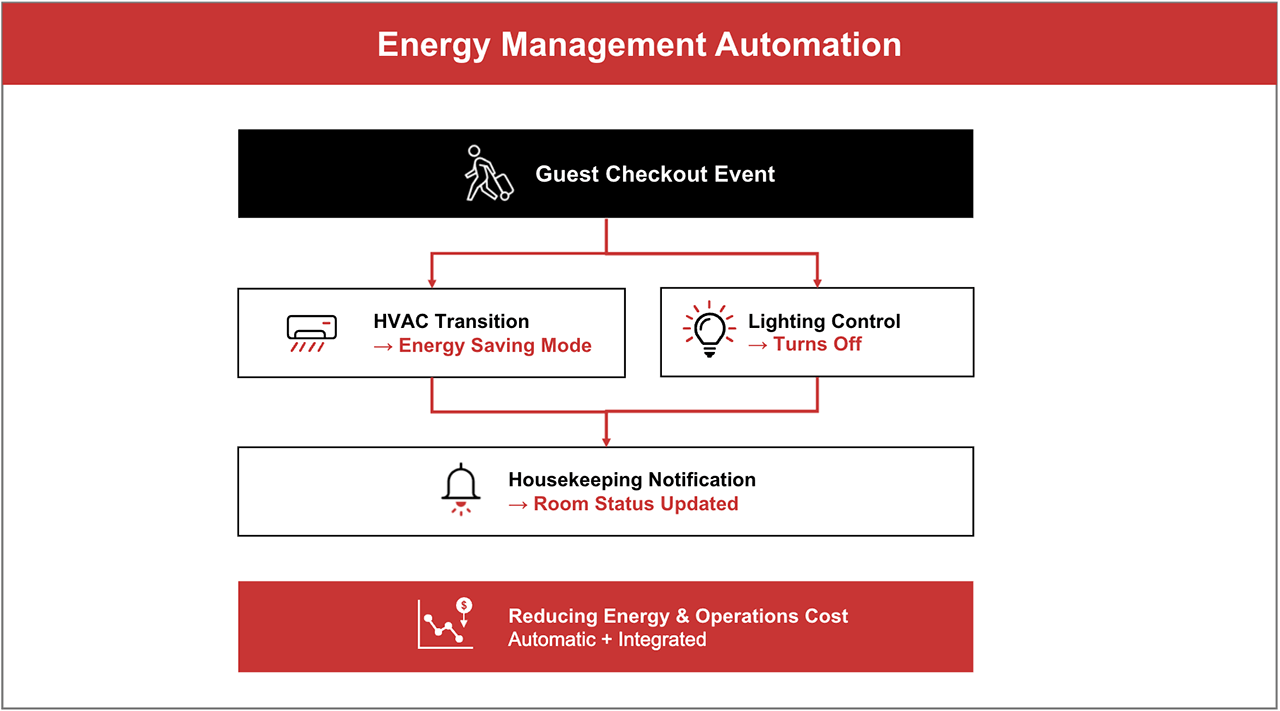
Solving these problems requires endpoints that can securely exchange information, respond locally to occupancy changes, and scale across hundreds or thousands of devices without increasing deployment complexity.
In other words, scalable energy management starts with scalable wireless endpoints.
Why Z-Wave Long Range for Energy Management Devices?
Hotels and MDUs present unique connectivity challenges. Devices are distributed across multiple floors, concrete walls reduce signal propagation, and many endpoints must operate on batteries for years with minimal maintenance.
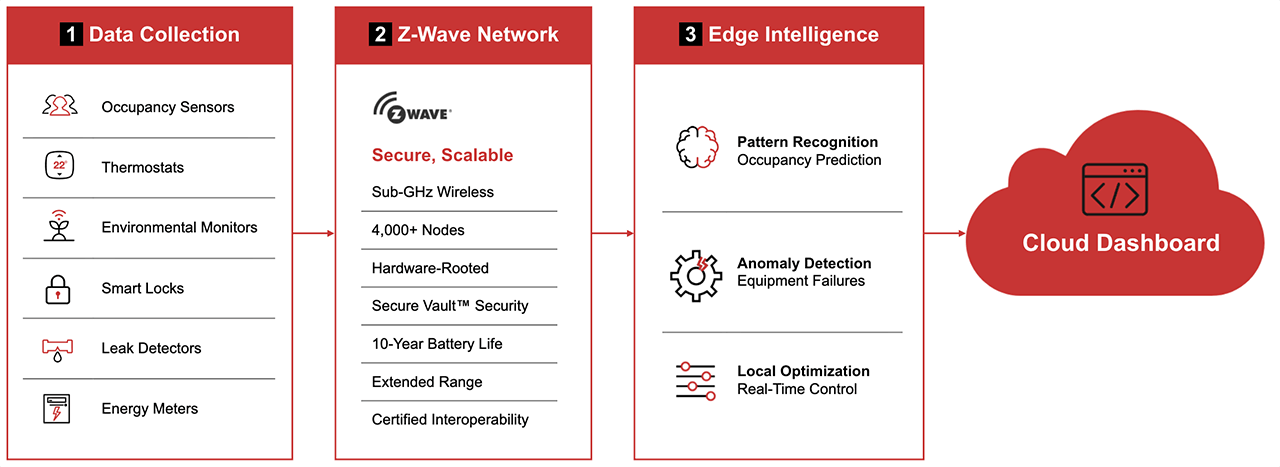
Z-Wave Long Range addresses these challenges by extending reliable Sub-GHz communication while supporting significantly larger endpoint populations than traditional residential deployments. The combination of long-range communication, low-power operation, and certified interoperability enables occupancy sensors, thermostats, lighting controls, leak detectors, and smart locks to work together as a coordinated energy-management system.
Similarly, certified interoperability allows manufacturers to develop products that integrate into an established ecosystem, giving building operators greater flexibility when selecting devices while reducing deployment risk and protecting long-term infrastructure investments.
For developers, this means building products that can support both today's installations and tomorrow's larger, more intelligent properties without redesigning the underlying wireless architecture.
Designing Better Energy-Management Devices with Z-Wave Long Range
Building intelligent endpoints requires more than selecting a wireless protocol. Developers must balance battery life, security, installation simplicity, application complexity, and long product lifecycles within a single device.
Silicon Labs addresses these challenges through a combination of low-power wireless hardware, integrated security, certified software, and a comprehensive development ecosystem. The EFR32ZG28 demonstrates how these capabilities come together for next-generation Z-Wave Long Range products.
One practical challenge is commissioning hundreds of devices across a large property. The EFR32ZG28 combines Z-Wave Long Range connectivity with optional Bluetooth® Low Energy, enabling installers to use familiar mobile workflows for device commissioning and servicing while maintaining robust connectivity through the Z-Wave network. Part of the Z-Wave 800 family, the ZG28 combines energy-efficient operation, strong RF performance, long-range connectivity, and industry-leading security.
Connected thermostats, locks, and environmental sensors may remain deployed for more than a decade while controlling critical building functions, making security a non-negotiable aspect of development. Secure Vault™ provides hardware-rooted protection for device identities, cryptographic keys, secure boot, and firmware integrity, helping developers build products designed for long-term operation and evolving cybersecurity requirements.
Application complexity also continues to grow. Modern energy-management devices increasingly combine sensing, user interfaces, local control algorithms, firmware updates, and multiple communication interfaces. The EFR32ZG28 provides additional memory and processing resources that give developers room to expand application functionality without requiring a hardware redesign as products evolve.
Edge processing is becoming equally important for practical energy-management applications. Rather than transmitting every sensor event to the cloud, endpoints can locally distinguish between brief movement and sustained room occupancy before triggering HVAC or lighting adjustments. This reduces unnecessary network traffic while enabling faster responses to changing conditions. Integrated AI/ML acceleration provides additional headroom for these evolving endpoint functions as occupancy sensing and environmental monitoring become more sophisticated.
Accelerating Commercial Energy Management Product Device Development
Developing a commercial energy-management product involves considerably more than selecting a wireless SoC. Engineering teams must integrate protocol software, implement security, complete certification, optimize battery life, validate wireless performance, and maintain products throughout long deployment lifecycles.
Developers building energy-management applications can accelerate their workflow using Silicon Labs' Simplicity Studio, a unified development platform that brings together SDKs, network analysis, and energy-profiling tools in one place. By handling the complexity of foundational technology integration, Simplicity Studio makes it possible for engineers to focus on building differentiated features that deliver real, measurable value to property operators.
Building the Next Generation of Intelligent Buildings
The next phase of energy management will be defined not by the number of connected devices, but by how intelligently they work together to understand occupancy, anticipate energy demand, and adapt building operations in real time. As buildings continue to evolve, developers will face new questions. How can endpoints make more decisions locally while maintaining ultra-low power consumption? How can thousands of connected devices remain secure throughout decade-long deployments? How can building systems become more autonomous without increasing complexity for installers and operators?
The answers to these questions will shape the next generation of intelligent buildings, and the wireless endpoints being designed today will play a central role in enabling that future.