


The FG23L SoC Brings Cost-Optimized Sub-GHz Wireless to Large Scale IoT Deployment
IoT deployments are moving from pilot programs to scaled rollouts, and the conversation is changing.
As deployments scale, different application tiers demand different optimization points. High-end platforms are built to manage complex, multiprotocol, and mesh networking environments. Broad-market deployments, however, prioritize streamlined capability—long-range, multi-year battery life, deterministic responsiveness, built-in security, and cost structures aligned with volume production.
That’s the design philosophy behind Silicon Labs’ EFR32FG23L sub-GHz wireless SoC.
Sub-GHz Wireless: Designed for Structured, Real-World Architectures
Many high-volume sub-GHz systems follow structured topologies such as sensor-to-gateway, remote-to-controller, and endpoint-to-hub. These are not massive mesh networks, but purpose-built wireless links that prioritize predictability, fast response, and architectural simplicity.
Designing Large Scale Sub-GHz Wireless Systems Requires Discipline
The EFR32FG23L SoC was built specifically for these types of deployments. Rather than carrying the overhead of multiprotocol stacks intended for complex network coordination, FG23L delivers a streamlined architecture optimized for proprietary and star network topologies. The result is a tightly integrated platform that balances performance, memory footprint, and cost efficiency.
This approach allows developers to focus on what matters most: building responsive, reliable wireless products without paying for silicon they don’t need.
Extending Sub-GHz Wireless Range Where It Matters
Sub-GHz connectivity continues to be the preferred choice for applications that demand deep penetration, extended coverage, and reliable performance in challenging RF environments.
From industrial campuses and agricultural fields to commercial buildings and residential perimeters, longer range directly impacts system economics. Fewer gateways. Simplified installation. Lower infrastructure costs.
The FG23L SoC supports global sub-GHz bands and delivers a strong link budget that enables robust connectivity across diverse deployment scenarios. Whether navigating dense industrial structures or covering wide outdoor spaces, the device is engineered to maintain reliable communication over distance.
In this context, range is just as much a business enabler as an RF metric.
Deterministic Communication for Responsive Systems
In many sub-GHz applications, timing is everything.
A remote key fob has to respond instantly, an access control system needs to be authenticated without delay, and an industrial safety trigger cannot tolerate uncertainty.
These use cases demand deterministic, low-latency communication rather than complex routing protocols. By leveraging Silicon Labs’ RAIL (Radio Abstraction Interface Layer), developers can implement custom PHY and MAC layers that are optimized for responsiveness and efficiency. This flexibility allows precise control over airtime, data rate, and power consumption assuring predictable system behavior.
For designers building proprietary wireless systems, this level of control is often more valuable than protocol breadth.
Power Efficiency That Enables Large Scale IoT
Battery life remains one of the defining constraints in IoT design. Maintenance costs, service intervals, and user experience are all shaped by energy consumption.
The FG23L SoC is engineered to support multi-year battery operation across a wide range of endpoint devices. Its low sleep currents, fast wake-up capabilities, and intelligent low-power listening modes allow systems to remain energy-efficient without sacrificing responsiveness.
From security sensors and smart agriculture nodes to consumer remotes and monitoring devices, efficient power design directly reduces operational costs and supports large-scale deployment models.
At scale, every microamp matters.
Security as a Foundation, Not an Afterthought
As IoT devices proliferate across industrial and residential environments, security expectations rise. Device identity, encrypted communication, and secure firmware management are baseline requirements.
The FG23L integrates Secure Vault™ embedding hardware-rooted security directly into the device architecture. Secure boot, hardware-accelerated cryptography, secure debug capabilities, and advanced protection mechanisms provide a strong foundation without requiring external security components.
By integrating security at the silicon level, developers can meet modern protection requirements while maintaining cost and design efficiency.
Multicore Architecture and Integration That Simplifies System Design
With dedicated cores for application, radio, and secure engine, the FG23L SoC provides ample compute headroom to minimize protocol and application processing latency, ensuring responsive sub-GHz wireless communication.
In cost-sensitive designs, integration drives advantage, and the FG23L brings together a rich set of analog and digital peripherals to support real-world product requirements, including precision data acquisition, autonomous sensing, flexible communication interfaces, and extensive GPIO to enable compact, single-chip solutions.
Higher integration also reduces external components, simplifies PCB layout, and accelerates development cycles. For manufacturers targeting competitive markets, these efficiencies translate directly into lower total system cost and faster time to market.
FG23L Sub-GHz SoC: Built for Broad-Market Opportunity
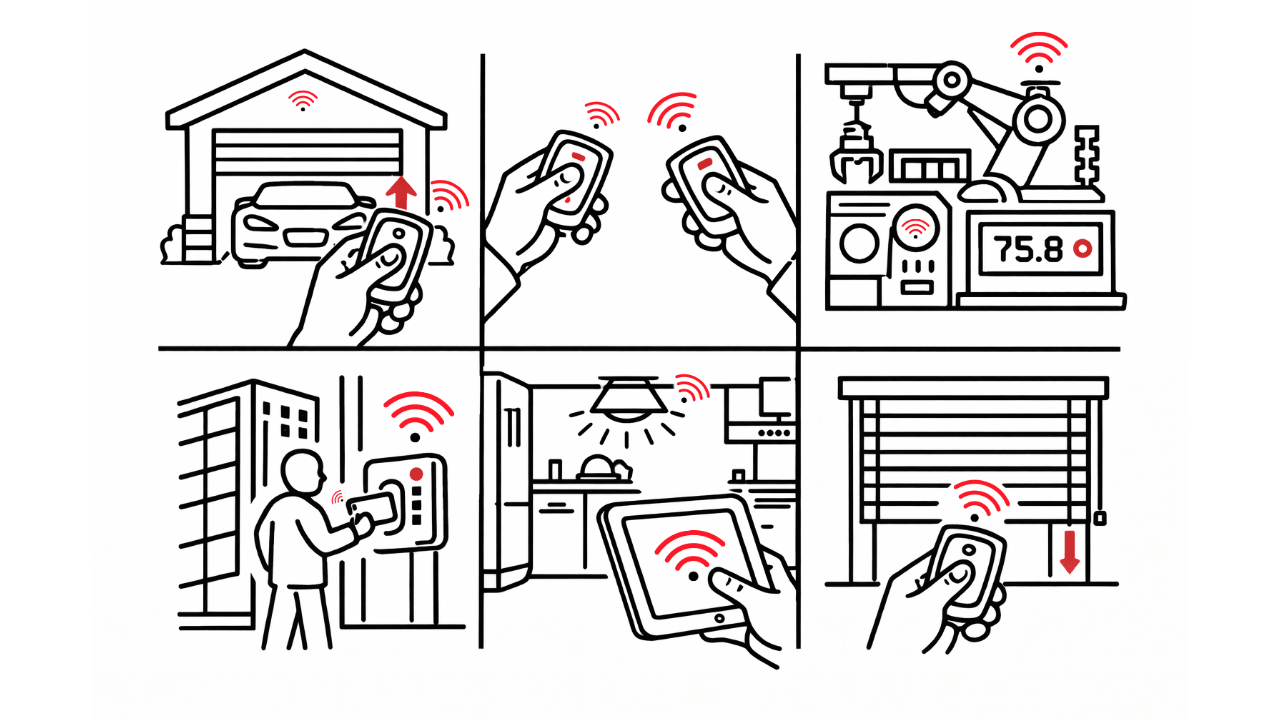
Sub-GHz technology continues to expand beyond traditional industrial niches into commercial infrastructure and home automation ecosystems. Wireless I/O modules, condition monitoring systems, building automation platforms, lighting control, access systems, smart locks, perimeter sensors, and remote-control devices all share a common set of requirements: structured communication, long-range reliability, battery-powered operation, hardware-rooted security, and cost alignment for volume deployment.
The FG23L was designed precisely to meet these design requirements.
Focused Capability for the Next Phase of Sub-GHz IoT Growth
The future of sub-GHz IoT growth won’t be driven by maximum feature density as much as by focused capability and devices that deliver the performance designers need while eliminating unnecessary overhead.
The FG23L sub-GHz wireless SoC embodies this trend, combining low cost, long-range connectivity, deterministic communication, integrated security, ultra-low power operation, and streamlined memory into a cost-optimized platform tailored for scale.
As IoT continues its transition from specialized deployments to mainstream infrastructure, right-sized wireless solutions will define competitive advantage.