


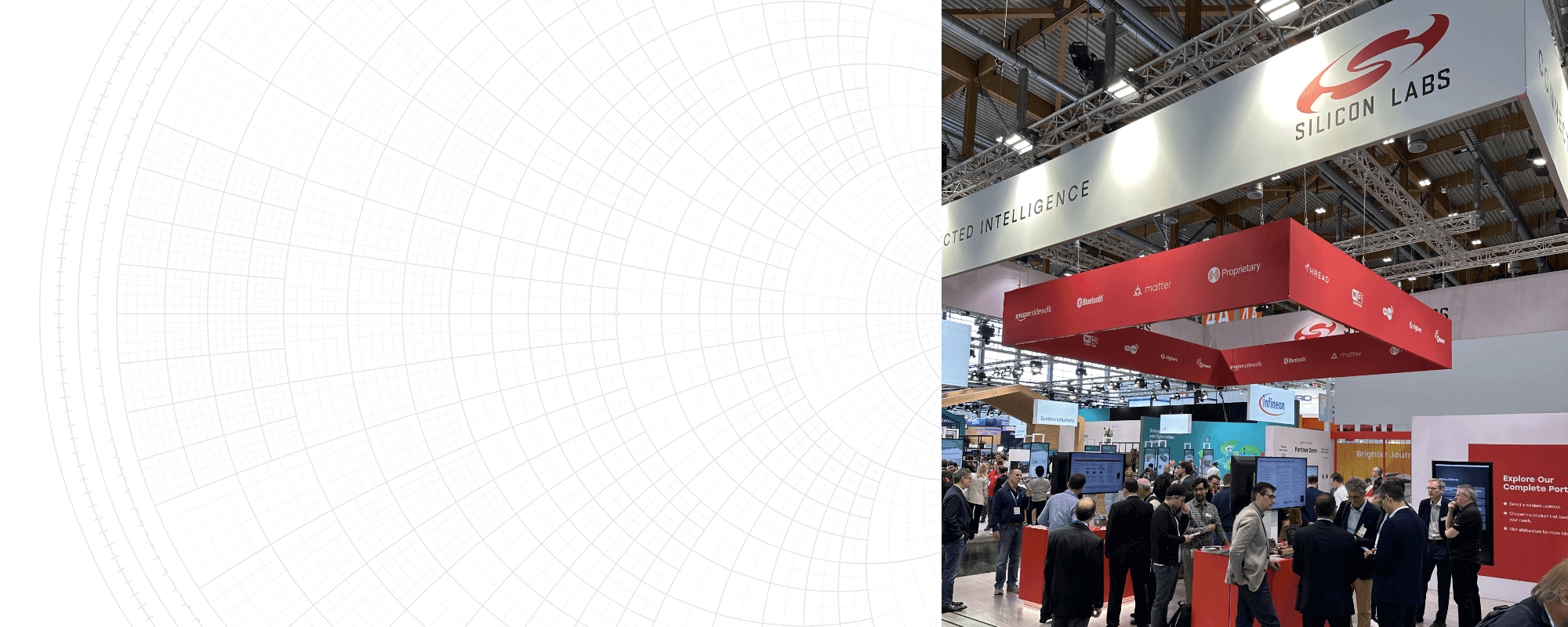
March 10-12, 2026 | Nuremberg, Germany
Connect with Silicon Labs at embedded world 2026
Booths 4A-128 & 4A-129
Click Here to Request a Meeting With Our Team at embedded world
Explore embedded world 2026 Demos
Machine Learning
- ModelCat Demo: showcases real-time face and gesture recognition running entirely on a low-power MCU—no cloud required. Using the Silicon Labs EFR32MG26 wireless SoC and ModelCat’s Aptos™ platform, advanced machine learning vision models execute locally with millisecond-level inference times and extremely low energy consumption.
- ML-Enabled Real-Time Positioning: This demo, developed with Unikie, showcases machine learning–enabled positioning running on Silicon Labs EFR32BG24 SoCs to deliver intelligent Bluetooth-based tire localization for TPMS applications. Using a compact 2 x 2 antenna configuration, the system achieves accurate real-time positioning with very low memory and compute requirements. The ML algorithms enhance localization accuracy and system robustness while maintaining low latency and power consumption. The same scalable architecture can be applied to indoor asset tracking, smart access control, secure door locks, and other proximity-based applications.
- MCU Motor Control Demo: showcases the compute capabilities of Silicon Labs Series 2 MCUs by combining high-RPM motor control, wireless connectivity, and on-device ML on a single SoC. The system runs deterministic real-time motor control under constant load while simultaneously supporting BLE using an RTOS, and offloads ML inference to the on-chip MVP accelerator for condition monitoring or anomaly detection—without impacting control timing or wireless performance.
Bluetooth
- Channel Sounding Ranging Demo: showcases Bluetooth Channel Sounding–based distance ranging using Silicon Labs’ xG24-DK2606A development kit and Android devices—including a smartphone and smartwatch—highlighting real-world interoperability across consumer and embedded platforms. By enabling reliable distance measurements between heterogeneous devices, the demo illustrates how Bluetooth Channel Sounding supports scalable, interoperable ranging applications across the broader Bluetooth ecosystem.
- Channel Sounding Automapping Demo: shows how Bluetooth Channel Sounding adds spatial awareness to existing Bluetooth nodes, enabling devices to automatically discover relative positions and build a 2D geometric map. Using multiple Channel Sounding development kits and an observer node, the system performs coordinated ranging to reconstruct the layout of devices within a space. The demo highlights how Channel Sounding enables automapping and simplified commissioning for applications such as access points, smart lighting, and solar installations—reducing installation time, manual configuration, and overall system cost by leveraging Bluetooth .
- Bluetooth Channel Sounding based PEPS and TPMS Demo: This demo showcases Bluetooth Channel Sounding–based Passive Entry Passive Start (PEPS) and Tire Pressure Monitoring System (TPMS) use cases using a toy car platform. Channel Sounding enables precise, secure distance ranging between the vehicle and a user device, supporting hands-free entry and start through reliable proximity detection. The demo also highlights Bluetooth-based TPMS, enabling wireless tire pressure data delivery to in-vehicle systems or user devices for real-time monitoring and alerts—without additional radios. Together, these use cases demonstrate how Channel Sounding and Bluetooth connectivity enable scalable, low-cost automotive features
Matter
As smart home platforms converge around Matter, energy management is emerging as a major opportunity for the next wave of connected devices for the home. This demo will show Silicon Labs hardware running our EVSE Sample Application simulating interaction with the grid and solar panels and being displayed on Home Assistant.
Wi-Fi
As Wi-Fi becomes more popular for IoT end devices, low-power has become a critical features for battery powered devices. This demo will feature our reference design for a low-power camera implementation as well as a demonstration of a low-power multiprotocol (Wi-Fi + Bluetooth LE) application.
Zephyr Booth - Hall 4-170
This demo highlights how Zephyr enables platform-level code portability across Silicon Labs Series 2 and SiWx917 Wi-Fi platforms. Using a common Zephyr-based application framework, developers can reuse core application code across multiple wireless technologies with minimal changes. This approach simplifies development and accelerates expansion across Bluetooth, Matter, and Wi-Fi products.
Join our Technical Sessions
Date: March 10, 2026 | Start: 13:45
Session 1.2 – IoT & Connectivity: IoT Ecosystem Technologies 1
14:45 | 30 Min
Zigbee 4.0: Connecting Devices Safely, with Low Power Efficiency Across Generations
Zigbee 4.0 builds on a decade of deployment in smart energy, home automation, and industrial IoT applications. It is based on the Zigbee stack revision 2023, ZCL revision 8, and BDB 3.1, and represents a major step forward in security, reliability, and network flexibility for embedded devices. A major enhancement is dynamic link key negotiation using Curve25519 and P-256, providing strong forward secrecy and secure device onboarding. APS frame counter synchronization ensures message integrity and prevents replay attacks, improving overall network resilience. The device interview process has been refined for smoother network integration, while multi-PAN support allows devices to operate in overlapping networks without conflict. For dense, low-power networks, Coordinated Sampled Listening (CSL) offers predictable wake and sleep cycles, conserving energy without sacrificing responsiveness. Zigbee 4.0 continues profile harmonization, bridging Smart Energy and Zigbee 3.0 profiles to simplify multi-domain deployments. On the commissioning side, Zigbee Direct enables provisioning and control via Bluetooth LE, reducing installation friction and extending interoperability. This session covers key protocol improvements, migration considerations, and practical guidance for embedded engineers designing the next generation of Zigbee-enabled devices.

Faisal Bhaiyat | Silicon Labs
Faisal Bhaiyat is a Software Architect at Silicon Labs, Chair of the Zigbee Pro Core Technical Sub Group at the Connectivity Standards Alliance, and Chair of the Zigbee Certification Sub Group at the Connectivity Standards Alliance.
Date: March 10, 2026 | Start: 16:00
Session 1.3 – IoT & Connectivity: IoT Ecosystem Technologies 2
16:30 | 30 Min
Multiprotocol Connectivity in Smart Homes: Enhancing Interoperability and User Experience
The smart home market continues to grow at a steady pace of 15–20% annually, driven by applications such as lighting, climate control, security, and appliances. Major ecosystems including Apple, Amazon, Google, Samsung, and Tuya are accelerating this growth by adopting standardized technologies such as Matter. Despite this, global adoption remains fragmented, with a wide variety of wireless protocols in use and an overall penetration rate below 20%. This fragmentation presents a challenge for product vendors aiming to deliver consistent user experience across diverse ecosystems. While Matter is a step toward unification, its global rollout will take time. Multiprotocol solutions offer a practical bridge by enabling devices to support multiple wireless standards such as Zigbee, Thread, and Bluetooth, allowing communication across ecosystems. This paper explores multiprotocol techniques that allow a single device to operate across multiple protocol networks. It examines how this approach enhances user experience, simplifies ecosystem integration, and reduces the need for multiple SKUs. Real-world use cases and design considerations are highlighted from a user-centric perspective, emphasizing interoperability, flexibility, and future-proofing in connected environments.

Devanjan Sikdar | Silicon Labs
Devanjan Sikdar is a Product Marketing Manager at Silicon Labs, where he leads marketing initiatives for smart home technologies including Zigbee, Thread, and Matter. Prior to Silicon Labs, he was part of the Redpine Signals acquisition, focusing on real-time location systems for Wi-Fi products. He holds a degree in Computer Science Engineering from VIT Vellore and a Post Graduate Diploma in Management from NMIMS. He has authored numerous blogs and white papers on smart home technologies and is a frequent speaker at industry seminars and events.
The sessions, IoT and Connectivity 1.2 and 1.3, have multiple speakers, so the first start timess in each of them is the start of the full session, the second start times (14:45 for Faisal and 16:30 for Devanjan) are the times they wll actually take the stage