

Introducing ZPC - A Faster and Extensible Approach to Z-Wave Controller Development
Manufacturers of wireless devices are always looking to design products that deliver valuable and differentiated experiences to customers. While developing any wireless product involves complexity, building a Z-Wave hub or gateway brings a distinct set of controller responsibilities. The gateway must securely onboard and manage devices from different manufacturers, understand their capabilities through Z-Wave Command Classes, maintain network and device state, manage security and network operations, and support devices with different behaviors and capabilities. Implementing and maintaining this host-side controller functionality can require significant engineering effort before developers can focus on the features and experiences that differentiate their products.
Manufacturers of wireless devices are always looking to design products that deliver valuable experiences to customers. But for developers building Z-Wave hubs and gateways, significant engineering effort is required before creating that differentiated experience.
Network management, secure device onboarding, device discovery, firmware management, application integration, and support for diverse Z-Wave device capabilities all need to work together reliably.
The new Z-Wave Protocol Controller (ZPC) from Silicon Labs is designed to simplify that foundation, helping developers accelerate Z-Wave controller development and focus more of their engineering resources on the applications and experiences that differentiate their products.
A Modern Foundation for Z-Wave Controller Development
ZPC provides the host-side functionality needed to control and manage a Z-Wave network using a Silicon Labs Z-Wave Network Co-Processor (NCP). It operates as a central static controller and provides network management, device control, and state synchronization capabilities through an MQTT-based communication interface.
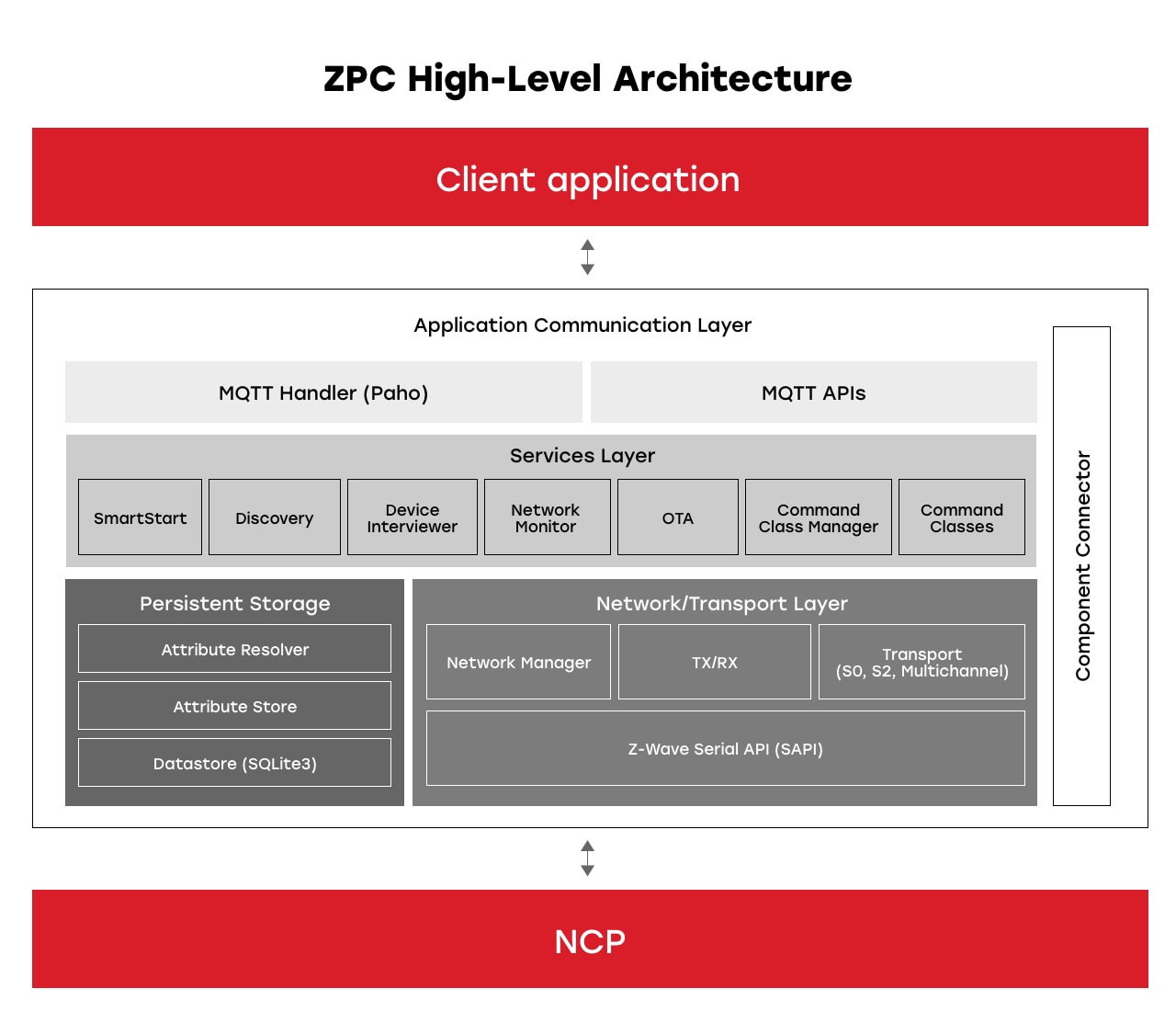
The ZPC architecture creates a clear separation between the customer application and the underlying Z-Wave network.
ZPC works with Silicon Labs’ Z-Wave NCP on the EFR32ZG23 and EFR32ZG28 SoCs, creating a complete host-to-network development path. The NCP provides the Z-Wave connectivity and communicates with ZPC through the Serial API, while ZPC manages the host-side controller functionality and application integration.
For developers, this means the application can focus on product functionality while ZPC provides the foundational controller capabilities needed to interact with the Z-Wave network.
The MQTT-based interface also provides a flexible integration point for customer applications, GUIs, cloud services, and bridges to other protocols or services.
Bringing Essential Z-Wave Controller Capabilities Together
A Z-Wave controller must support much more than simply sending commands to devices, and ZPC brings a broad set of controller services together within one solution. Its MQTT-based APIs support network management, Z-Wave SmartStart, device discovery and interviewing, network status, over-the-air updates, firmware updates, and Z-Wave Command Class control. ZPC also maintains a persistent attribute store with reported and desired value synchronization for Z-Wave device states.
Together, these capabilities help simplify key stages of the device lifecycle, like adding and discovering devices to monitoring network status and maintaining deployed products through firmware updates.
ZPC Makes Application Integration Simpler
As products evolve, gateways need to be able to interact with multiple applications and services.
ZPC uses MQTT as its application-facing communication interface, providing APIs that abstract Z-Wave controller operations from the customer application. This enables applications to interact with Z-Wave devices and network services without directly implementing the underlying Z-Wave protocol behavior.
This separation also makes it easier to build different experiences on top of the same controller foundation.
ZPC Enables Extensible Development
Product requirements continue to evolve after the initial controller implementation. ZPC is designed with extensible development in mind, giving developers the resources and flexibility to build on the controller foundation as their requirements grow.
Silicon Labs provides comprehensive documentation, API references, release information, and development resources to support integration and customization. For developers adding Z-Wave functionality, an automated code-generation solution streamlines new Command Class implementation, thereby reducing repetitive development effort and provides a structured approach to extending controller capabilities.
Extending the Opportunity with Z-Wave Long Range
Z-Wave applications are increasingly moving beyond devices located within the traditional boundaries of the home. Z-Wave Long Range expands the opportunity to reach devices across larger properties and commercial applications.
ZPC works with Silicon Labs Z-Wave NCP to provide a controller foundation capable of supporting both Z-Wave and Z-Wave Long Range deployments with compatible hardware and software configurations.
For customers, this provides a path to address evolving Z-Wave use cases without changing the fundamental host-controller model.
Z-Wave Protocol Controller is Progressing Toward Certification
ZPC is now generally available (GA) and ready for certification, providing customers with a platform to develop commercial Z-Wave controller products.
Z-Wave certification is targeted for completion by the end of Q4 2026, marking a key milestone toward certified commercial deployments.
Focus Engineering Where It Matters
Developers shouldn't have to recreate foundational connectivity functionality every time they build a new gateway or controller product.
By bringing together network management, SmartStart, device discovery, monitoring, OTA firmware management, Command Class control, MQTT-based application integration, and extensible development, ZPC provides a modern foundation for developing the next generation of Z-Wave controller solutions.
Combined with the development tools, documentation, and deep Z-Wave expertise, ZPC will help developers spend less time building the controller foundation and more time creating the products and experiences that make their solutions different.